


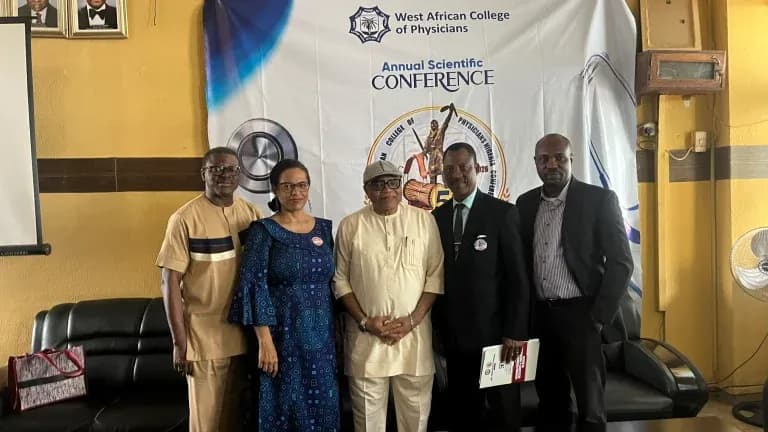
The demand matters because it comes from inside the system, not outside it. This is the professional body that trains and certifies Nigeria's specialist physicians, and it says the gaps it identified, in financing, training infrastructure and rural access, are structural rather than incidental. The college delivered its findings at the close of a meeting that ran nearly a week and drew hundreds of doctors from across West Africa.
The Chairman of the college's Nigeria Chapter, Prof. Benjamin Uzochukwu, laid out the numbers at a press conference in Ibadan. The 50th Annual General and Scientific Meeting drew 434 participants. Of those, 351 attended in person and 83 joined virtually, a mix that included fellows, resident doctors, researchers, policymakers and public health stakeholders from Nigeria and neighboring countries. The meeting ran July 5 to 11 at the International Conference Centre in Ibadan, under the theme "Building Bridges, Forging Resilience and Partnership in Health."
Uzochukwu, who is also a vice president of the parent college, said deliberations centered on three areas. Doctors reimagined medical training. They examined affordable digital technologies for patient care. And they debated how to build a stronger financial base for healthcare delivery. Each thread fed into the same diagnosis: a health system where the parts do not talk to each other.
"The discussions identified persistent disconnects within Nigeria's health system," Uzochukwu said, naming gaps between medical disciplines, between laboratories and clinics, and between policy formulation and implementation. He added inequality between urban and rural communities to that list. None of it is new territory for Nigerian health policy. What the college is doing here is putting its institutional name behind a specific set of remedies, and doing so on the record, in a signed set of resolutions.
What the college is asking for
The core demand is financing. The college resolved that governments at every level must move past temporary interventions. Uzochukwu said the resolution calls for sustainable healthcare financing mechanisms, reliable utilities, an adequate workforce, improved infrastructure, diagnostic services and blood transfusion facilities. The phrase "beyond temporary interventions" is doing real work here. It is a direct jab at a familiar pattern in Nigerian health policy: emergency funding announced after a crisis, then allowed to lapse once headlines move on.
The second demand targets training. The college wants postgraduate training institutions to set minimum infrastructure standards. Attached to that is a broader list: stronger multidisciplinary care, incentives for rural practice, more research support, formal mentorship programs, diaspora engagement, and better data systems tracking the health workforce itself. That last item is notable. Nigeria's Ministry of Health has long lacked a reliable national count of practicing specialists, a gap that makes workforce planning close to guesswork.
The third thread is technology, and here the college was specific about scale. Uzochukwu said the college is pushing affordable digital tools to standardize postgraduate training rather than expensive infrastructure builds. He listed artificial intelligence assisted tutoring, spaced repetition flashcards, virtual patient simulations, three dimensional anatomy platforms and e-learning systems as tools that could extend training beyond bedside teaching. His framing was careful. "Technology should complement, not substitute, clinical training and skills acquisition," he said, a line that reads as a preemptive answer to critics who might worry digital tools are being pitched as a cheaper stand-in for supervised clinical practice.
Related News
- Nigerian traditional ruler, campaign director calls for religious unity ahead of 2027 vote
- Dangote Industries Nigeria Limited has been awarded two federal road contracts in Borno State
- The House of Representatives Committee on Crude Oil Theft called Thursday for a special court to try oil thieves and saboteurs, arguing existing legislation is too weak to deter the crimes.
The urban-rural divide runs through all three demands. Uzochukwu said the college wants bridges built across medical disciplines, between policy and practice, and between urban and rural communities, language he tied directly to the conference theme of resilience and partnership. Rural incentive schemes for physicians have existed in various forms in Nigeria before, tied to hazard allowances or relocation grants. What is not yet clear from Saturday's statement is whether the college is proposing something structurally different, or restating a policy ask that has circulated for years without full implementation.
The college's own numbers offer a comparison point often missing from these debates. A gathering of 434 registered medical specialists, most in Ibadan for a full week, in person, represents a body of professional judgment that Abuja will find harder to wave off than a single advocacy letter. But numbers at a conference are not commitments from government. Nothing in Uzochukwu's remarks Saturday indicates the Federal Ministry of Health has responded to the resolutions, or whether state governments in attendance, if any were, have taken a position.
That is where this story now sits. The West African College of Physicians has put a detailed set of financing and training demands on the record, sourced to its Nigeria Chapter chairman and dated to the close of its 50th annual meeting. What has not happened yet is any government response, at federal or state level, confirming whether the specific asks, sustainable financing mechanisms, minimum infrastructure standards for postgraduate training, workforce data systems, will be taken up. Until Abuja or a state health ministry answers on the record, the resolutions remain a professional body's diagnosis without a patient's treatment plan.
Add a Comment