


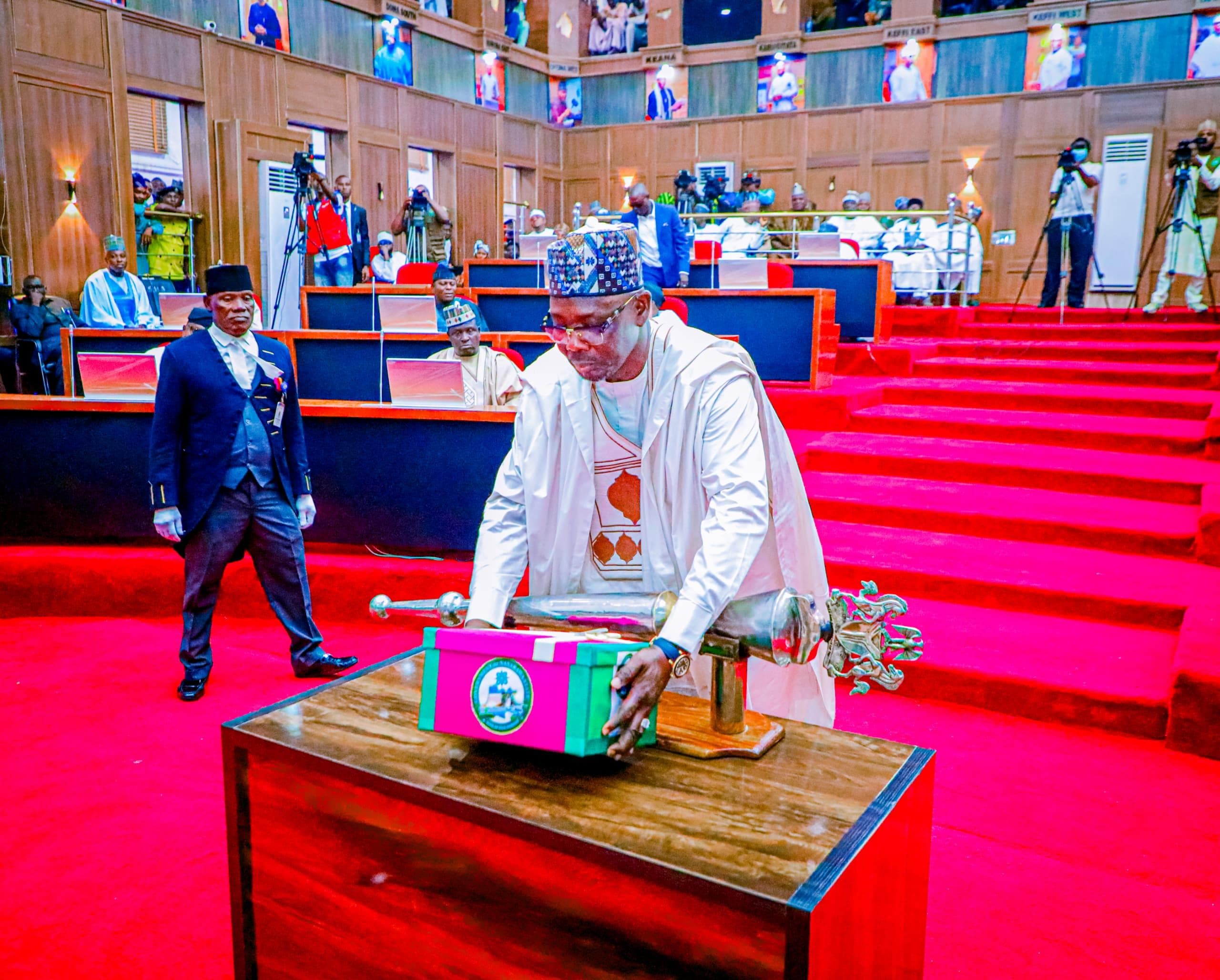
Delta and Nasarawa governors on Thursday laid their 2026 Appropriation Bills before their respective Houses of Assembly, setting out ambitious spending plans aimed at expanding infrastructure, improving services and strengthening state finances.
Governor Sheriff Oborevwori of Delta presented a proposed budget of N1.664 trillion, while Governor Abdullahi Sule of Nasarawa submitted a spending plan of N517.5 billion for the coming year.
Delta Prioritises Infrastructure and Revenue Growth
Presenting the estimates in Asaba, Governor Oborevwori explained that Delta’s proposal includes N499 billion for recurrent expenditure and N1.165 trillion for capital projects. According to the governor, the 2026 budget represents a 70 percent increase over the outgoing year’s plan.
He said the state expects to fund the budget largely through Statutory Allocation, Internally Generated Revenue, Mineral Derivation, VAT, capital receipts, as well as savings and oil revenue recoveries.
According to him, statutory allocation is projected at N720 billion, supported by improved post-subsidy FAAC inflows and more stable oil production in the Niger Delta. The governor also revealed that IGR is expected to rise to N250 billion, which he attributed to ongoing revenue reforms designed to plug leakages and broaden the tax base.
VAT inflows are forecast to reach N120 billion due to improved federal tax administration. Meanwhile, capital receipts have been deliberately reduced to N25 billion as part of what he described as a shift toward a zero-borrowing fiscal policy. Savings and oil recovery funds are expected to contribute N489 billion.
Oborevwori said personnel costs would take N185 billion and overheads N204 billion, while the remaining N110 billion in the recurrent component covers social contributions and grants. These projections, he added, take into account inflationary pressures and routine annual adjustments for public servants.
Related News
Major Capital Allocations in Delta
The proposed N1.165 trillion capital vote marks an 85 percent increase over the 2025 capital allocation. Key sectors include road infrastructure, which is expected to receive N450 billion. Education is allocated N105.086 billion and health N50.067 billion. The Delta State Capital Territory Development Agency and the Warri, Uvwie and Environs Development Agency are each slated to receive N20 billion.
Other allocations include N16 billion for power and energy, N10 billion for agriculture and N20 billion for social protection. An additional N100 billion is set aside for interventions across the state’s 25 local government areas.
Reviewing the performance of the 2025 budget, Oborevwori said revenue receipts between January and October stood at N738.64 billion, representing 90.5 percent of the pro rata target. He noted that recurrent expenditure reached 117 percent of projections, while overall spending achieved 97 percent performance. According to Punch reports, he praised the results as evidence that recent federal reforms are beginning to yield gains.
Speaker Emomotimi Guwor commended the administration, saying the proposed budget aligned with the governor’s development agenda.
Nasarawa Seeks Growth Through Strategic Consolidation
In Lafia, Governor Sule presented a N517.539 billion budget tagged Budget of Strategic Consolidation. He asked lawmakers to scrutinise the proposal and ensure prompt passage to sustain ongoing development efforts.
Speaker Danladi Jatau assured the governor of cooperation and pledged a timely review.
According to the governor, recurrent expenditure is estimated at N212.79 billion, while capital spending stands at N304.75 billion. He said the ratio reflects his administration’s continued push to prioritise capital investment.
A sectoral breakdown shows N108.70 billion for administration and N221.84 billion for the economic sector. The social sector is allocated N170.92 billion, while law and justice receives N16.09 billion.
Infrastructure takes the largest share at N157.80 billion. Education is allocated N92.91 billion, followed by governance and general administration at N142.96 billion. Other allocations include N37.19 billion for health, N31.85 billion for agriculture and water resources, N28.32 billion for environment and community development, and N18.65 billion for information and tourism.
Governor Sule said the proposal reflects his administration’s focus on industrialisation, SME expansion, agricultural productivity, improved social services, urban renewal and environmental sustainability.
Katsina Signs 2026 Budget
In Katsina, Governor Dikko Radda signed the state’s 2026 Appropriation Bill, known as Building Your Future III, after lawmakers returned the document without changes. The House of Assembly approved it within 21 days of submission.
The Katsina budget carries 18 percent recurrent expenditure and 81 percent capital expenditure. During the signing ceremony, the governor emphasised that the government held town hall meetings across all 361 wards before finalising the document. More than 70,000 residents were said to have participated, contributing their priorities to the budget.
Radda praised the collaboration between the executive and the legislature, noting that lawmakers had passed several government bills in recent months.
Add a Comment