


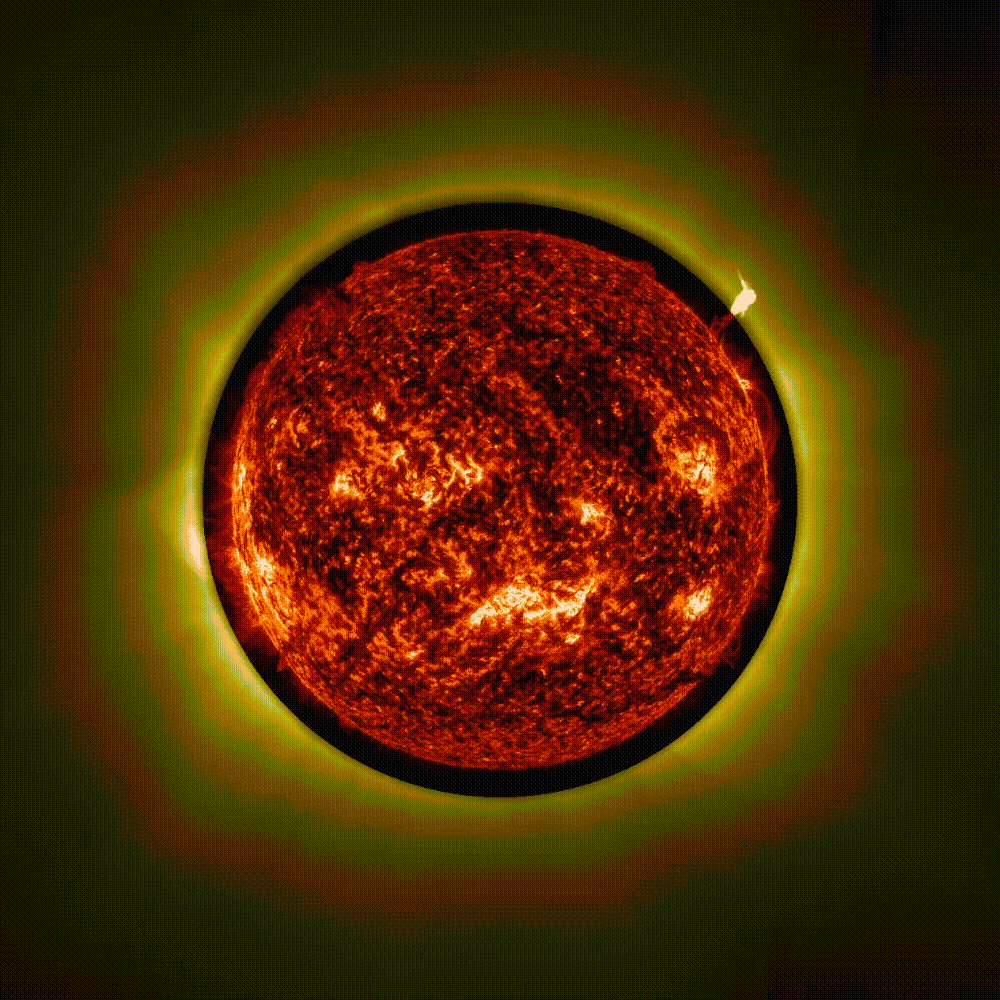
Scientists studying the Sun have captured unusually detailed views of the inner solar corona, the hottest region of the Sun’s atmosphere, thanks to a pioneering European Space Agency mission designed to create artificial solar eclipses in orbit. New imagery from Proba-3 shows multiple solar prominence eruptions unfolding within just a few hours, offering rare insight into one of the least understood regions of our star.
The images were produced using the ASPIICS coronagraph aboard Proba-3, an ESA mission made up of two spacecraft flying in precisely controlled formation. Working together, the satellites block out the bright solar disc, allowing instruments to observe the faint corona with exceptional clarity. In the resulting time-lapse animation, the inner corona appears as a pale yellow glow, revealing complex structures and rapid activity that are usually hidden from view.
According to the European Space Agency, the observations were made on September 21, 2025, during a particularly active period on the Sun. Over the course of five hours, ASPIICS captured images every five minutes, documenting three separate prominence eruptions in quick succession.
Why the Solar Corona Matters
The Sun’s corona has long puzzled scientists. Despite being farther from the solar core than the surface, it is dramatically hotter, reaching temperatures of several million degrees. By comparison, the Sun’s visible surface is far cooler.
“The corona is extremely hot, about two hundred times hotter than the Sun’s surface,” said Andrei Zhukov of the Royal Observatory of Belgium, who serves as the Principal Investigator for ASPIICS. Understanding why this temperature difference exists remains one of solar physics’ most enduring questions.
Occasionally, relatively cooler structures appear within this superheated environment. These formations, known as solar prominences, are made of dense plasma suspended above the Sun’s surface by magnetic fields. While cooler than the surrounding corona, they still reach temperatures of around 10,000 degrees.
“Sometimes, structures made of relatively cold plasma are observed near the Sun,” Zhukov explained. “Although these are still extremely hot by everyday standards, they are much colder than the surrounding million-degree corona. These structures form what we call a prominence.”
Related News
Capturing Rare Eruptions
Prominences are not always stable. Under certain conditions, they can expand outward and erupt, breaking apart and ejecting plasma into space. Such events can contribute to space weather phenomena that, when directed toward Earth, may disrupt satellites, communications, and power systems.
What makes the Proba-3 observation particularly notable is the number of eruptions recorded within such a short time window. Seeing three prominence eruptions in just five hours is considered uncommon.
“Seeing so many prominence eruptions in such a short timeframe is rare, so I’m very happy we managed to capture them so clearly during our observation window,” Zhukov said.
The clarity of the data is a direct result of ASPIICS’ ability to observe the innermost region of the corona, an area that has been difficult to study consistently using previous instruments.
How Proba-3 Creates Artificial Eclipses
Unlike traditional solar observatories, Proba-3 relies on two separate spacecraft flying tens of meters apart with extreme precision. One satellite carries a disc that blocks the Sun’s bright surface, while the other houses the ASPIICS coronagraph. This configuration mimics the effect of a total solar eclipse, but without the brief and unpredictable nature of eclipses observed from Earth.
A suite of onboard positioning and navigation technologies allows the spacecraft to maintain their alignment with millimeter accuracy. According to ESA, this capability enables long-duration and repeatable observations of the inner corona, filling a major gap in solar monitoring.
Scientists say this missing “puzzle piece” has limited understanding of how energy and magnetic fields behave close to the Sun’s surface, where many space weather events originate.
Seeing the Sun in Different Light
The animation released by ESA combines data from ASPIICS with imagery from NASA’s Solar Dynamics Observatory. While ASPIICS shows the inner corona in yellow tones, the solar disc is displayed in dark orange using data from the Atmospheric Imaging Assembly aboard the NASA spacecraft.
ASPIICS observes the Sun through several filters, including two specific spectral lines, each associated with different elements present in the coronal plasma. The prominence eruptions captured in the animation were recorded in a spectral line emitted by helium atoms.
This choice of wavelength produces a view similar to what the human eye might see during a total solar eclipse through a yellow filter. Meanwhile, the Solar Dynamics Observatory data shows helium emissions in another spectral line, allowing scientists to compare structures across different layers of the solar atmosphere.
The faint yellow glow that remains visible in the animation represents sunlight scattered by electrons in the corona, a key signal that helps researchers map the density and structure of the coronal plasma.
The Sun is approaching a period of heightened activity as it moves through its natural solar cycle. During such phases, eruptions, flares, and other energetic events become more frequent. High-quality, continuous observations of the corona are therefore increasingly important.
Solar physicists say data from Proba-3 could improve models used to forecast space weather, helping protect satellites, astronauts, and critical infrastructure on Earth. The mission also demonstrates new formation-flying technologies that could be applied to future space observatories.
Researchers are now analyzing the September 21 data in detail, looking for patterns in how prominences form, evolve, and erupt. Future Proba-3 observations will focus on capturing similar events over longer periods, allowing scientists to compare quiet and active phases of the Sun.
ESA expects the mission to continue delivering insights into the complex physics of the corona, particularly the mechanisms that heat it to such extreme temperatures.
By creating artificial solar eclipses in orbit, ESA’s Proba-3 mission is opening a new window into the Sun’s most mysterious layer. The rare capture of multiple prominence eruptions in a short time highlights the mission’s potential to reshape understanding of solar activity and its effects on the wider solar system. As analysis continues, scientists believe Proba-3 will play a central role in answering long-standing questions about how our star works and why its atmosphere behaves so differently from its surface.
Add a Comment