


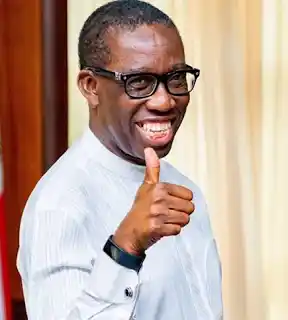
Former Delta State governor Ifeanyi Okowa formally declared for the Delta North Senate race in April 2026, setting up a direct political confrontation with incumbent senator Ned Nwoko inside the same party structure.
The declaration was made in Asaba, but its political consequences are already visible in Agbor and across the Anioma axis. Okowa’s allies framed the move as a “return to service.” His critics described it as an attempt to reclaim influence after the collapse of the Peoples Democratic Party structure in Delta State following the mass defections to the All Progressives Congress.
Okowa entered the race less than a year after defecting from the People's Democratic Party to the All Progressives Congress alongside Governor Sheriff Oborevwori. That movement shifted the political balance in Delta State almost overnight. APC inherited sitting commissioners, local government structures and ward coordinators that previously operated under PDP control.
But the Senate seat complicated the merger.
Delta North already has a serving APC senator in Ned Nwoko, elected in 2023 after years of failed attempts to secure the seat under different political alignments. Okowa’s entry transformed what could have been a routine re-election campaign into an internal struggle over hierarchy, loyalty and access to the state’s political machinery.
Agbor became a pressure point.
Agbor Political Networks Are Reassembling Around Okowa’s Old Structure
Agbor has long functioned as one of the strategic political centers in Delta North. Okowa’s influence in the wider Ika political bloc did not disappear after he left Government House in 2023. Former aides, council officials and ward organizers tied to his administration remain active across the area.
Related News
When Okowa hosted stakeholders from the nine Delta North local government areas in April 2026, the delegation included former lawmakers, serving officials and APC-aligned figures who had previously operated under the PDP structure he controlled for eight years.
The endorsements were carefully staged.
Public declarations supporting Okowa came from political actors who understand delegate arithmetic ahead of party primaries. In Delta politics, endorsements are rarely symbolic. They are usually signals about who controls local mobilization, transport funding and polling-unit coordination.
Our analysis of public endorsements released between January and April 2026 found that at least four pro-Okowa political groups referenced “experience” and “federal access” as reasons for backing his Senate return. Only one mentioned legislative performance metrics directly.
The contest increasingly looks less like an ideological argument and more like a struggle over who retains authority within the new APC order in Delta State.
Ned Nwoko’s Incumbency Faces Pressure From APC Realignment
Senator Ned Nwoko entered the Senate in 2023 with a different political calculation. At the time, APC was still structurally weaker in Delta North than PDP. Nwoko’s victory gave the party a foothold in a district long dominated by Okowa’s political network.
That advantage narrowed quickly after the defections.
By April 2025, Governor Oborevwori and Okowa had both moved into APC, bringing substantial state-level influence with them. Reports from Delta political meetings since then suggest that party control has increasingly shifted toward the governor’s bloc.
Nwoko now faces the unusual problem of incumbency without total control of party infrastructure.
Okowa worsened tensions when he publicly described his earlier support for Nwoko as a “mistake” during his Senate declaration event. The statement carried political weight because Okowa had previously played a role in coalition-building efforts within Delta North politics.
The relationship deteriorated publicly afterward.
Political observers in Delta North say the primary battle may ultimately depend on delegate loyalty within the APC rather than general voter popularity. That calculation favors whichever faction controls local executives and ward structures before the primary calendar is finalized.
Traditional Rulers and Stakeholders Are Being Drawn Into the Contest
Traditional institutions in Delta North have also become part of the emerging Senate equation. In April 2026, traditional rulers publicly backed Governor Oborevwori’s re-election and supported Okowa’s Senate return during a meeting at Abavo Kingdom.
Such endorsements are politically useful, even when they carry no formal electoral authority.
Royal fathers in Delta politics often serve as stabilizing intermediaries between factions, particularly in areas where political disputes risk fragmenting local patronage networks. Public alignment from traditional institutions can influence elite negotiations ahead of primaries.
Agbor politicians are watching those signals closely.
We reviewed statements issued by Delta North political groups after Okowa’s declaration. Nearly all referenced “Anioma unity” or “collective interest.” None addressed how APC would manage two heavyweight aspirants competing for one Senate ticket without internal fractures.
Open factional warfare before primaries could weaken APC internally and create opportunities for rival parties attempting to rebuild after the defections that reshaped Delta politics in 2025 and 2026.
Okowa’s Federal Ambitions Return Amid Unresolved Political Questions
Okowa previously served as senator representing Delta North before becoming governor in 2015. His return attempt is being presented by supporters as a continuation of representation rather than a political comeback.
The records suggest something broader.
A Senate seat would return Okowa directly to federal negotiations at a time when Delta’s political alliances are shifting ahead of the 2027 presidential election cycle. Senior politicians rarely seek Senate positions purely for legislative visibility. Committee influence, federal appointments and regional bargaining power remain central incentives.
Agbor voters understand that dynamic.
The challenge for Okowa is that his candidacy arrives with unresolved political baggage from the 2023 elections, including criticism surrounding his role as vice-presidential candidate on the PDP ticket and questions about the durability of his alliance with APC power brokers.
Those tensions remain beneath the surface.
Ifeanyi Okowa is attempting to reclaim federal influence through the Delta North Senate seat after defecting to APC.
Agbor remains one of the strongest operational bases for Okowa’s old political network despite the collapse of PDP dominance in Delta State.
Senator Ned Nwoko now faces a primary fight against a former governor with deeper control of local structures.
The APC in Delta State has not publicly explained how it plans to manage two heavyweight Senate contenders without factional fallout.
Why is Agbor important in this Senate race?
Because Agbor sits inside the wider Ika political structure where Okowa built much of his electoral machinery over the years. Local coordinators there still matter during primaries.
Can APC accommodate both Okowa and Ned Nwoko politically?
Possibly, but only if one side accepts compromise. Right now, both camps appear to be preparing for a direct contest.
Does Okowa still have influence after leaving office?
Yes. The April 2026 endorsements showed many former PDP figures and local stakeholders still align with him politically.
The unresolved issue now sits inside the APC’s primary structure in Delta North. The party has not released a final delegate framework or nomination timetable for the senatorial contest, and no agreement has emerged between the camps of Ifeanyi Okowa and Ned Nwoko. If disputes over delegate legitimacy or primary conduct reach the Federal High Court in Asaba before 2027, the fight over one Senate seat could become another prolonged legal battle over party control in Delta State.
Add a Comment