


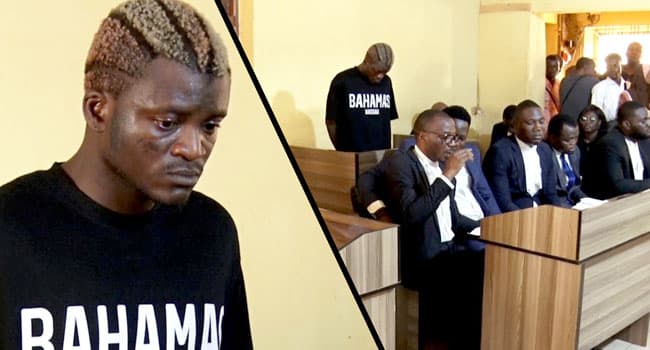
A Federal High Court sitting in Ota, Ogun State, on Monday declined to grant bail to controversial Nigerian singer Habeeb Okikiola, popularly known as Portable, following his arraignment on multiple criminal charges. The court ruled that a decision on bail would be deferred until the next hearing, citing the absence of a key police witness named in the case.
Portable was arraigned on allegations that include assault, resisting arrest, obstruction of a police officer, and theft. The development has renewed public attention on the singer’s long-running legal and personal controversies, many of which have played out publicly through social media and viral videos.
Confirming the arraignment, the Ogun State Police Public Relations Officer, Oluseyi Babaseyi, told journalists that the singer was arrested and charged before the court in Ota on Monday. “Yes, he was arraigned and remanded yesterday,” Babaseyi said on Tuesday.
Viral video precedes court appearance
Portable’s court appearance followed the circulation of a viral video on Sunday that showed the singer in handcuffs, shirtless, and visibly distressed while seated on a couch in what appeared to be a police holding area. In the footage, he was seen pleading tearfully, a scene that quickly spread across social media platforms and reignited debate about his repeated clashes with law enforcement.
According to police sources, his arrest was connected to allegations of assault involving actress and skit maker Omobolarinde Akinyanju, widely known as Ashabi Simple. Ashabi is one of the singer’s baby mamas and the mother of two of his children, a fact that has added a personal dimension to the legal dispute.
Details of the charges
In court, the prosecution outlined a series of allegations against the singer. According to Vanguard, prosecutors told the court that Portable allegedly attacked Ashabi alongside some police officers and other individuals at his bar in the Iyana Ilogbo area of Ogun State on New Year’s Day.
The charge sheet also listed several other alleged victims. They include Ileyemi Damilola, Akinyanju Oluwabusayomi, Olowu Olumide, Demilade Ogunniyi, and Ebuka Odah. Prosecutors alleged that the incidents occurred during a confrontation that escalated into violence.
In addition to the assault allegations, the prosecution accused the singer of stealing a Mercedes-Benz E300 valued at ₦12 million. The vehicle was said to belong to Ileyemi Damilola and was reportedly linked to a car dealership known as Wally Dex Auto.
Police further alleged that Portable obstructed and assaulted a female police inspector, Ogungbe Olayemi, while she was carrying out her official duties. This particular allegation became central to the court’s decision on bail.
Witnesses testify, key officer absent
During Monday’s proceedings, two siblings of Ashabi Simple appeared in court and testified as witnesses to the alleged assault. Their testimony formed part of the prosecution’s effort to establish a prima facie case against the singer at this early stage of the trial.
Ashabi herself, however, was not present in court. The reasons for her absence were not disclosed during the hearing, and the court did not indicate whether she would be expected to testify at a later date.
Crucially, the police inspector who was allegedly assaulted, Ogungbe Olayemi, was also absent from the proceedings. The presiding judge ruled that her presence was necessary before any consideration of bail could be made.
As a result, the court declined the bail application and ordered that Portable be remanded in custody. The judge adjourned the bail hearing to January 19, when the matter is expected to be revisited.
Legal analysts note that the court’s decision to defer bail underscores the seriousness with which allegations involving attacks on law enforcement officers are treated. According to Lagos-based criminal lawyer Kunle Adebayo, courts often exercise caution in granting bail when the alleged victim is a serving officer and has not yet testified.
Adebayo explained that the presence of the complainant allows the court to better assess the circumstances of the alleged offence and the likelihood of interference with witnesses. “It is not unusual for courts to insist on hearing from key parties before granting bail, especially in cases involving obstruction or assault on officers performing official duties,” he said.
The ruling also highlights a broader legal principle. While bail is generally regarded as a constitutional right, it is not automatic and may be denied or delayed depending on the facts before the court.
Investigation into alleged assault in custody
Meanwhile, the Ogun State Police Command has ordered an investigation into a separate viral video that allegedly shows the singer being assaulted while in police custody. The footage, which emerged shortly after his arrest, has drawn criticism from rights advocates and members of the public.
According to police sources, the investigation is aimed at determining the authenticity of the video and whether any officers violated established procedures. The command has said it will take appropriate disciplinary action if misconduct is established.
Human rights groups say the investigation is significant, as allegations of abuse in custody have long undermined public confidence in law enforcement. According to a statement from a Lagos-based civil rights organisation, any confirmed assault on a suspect would amount to a violation of constitutional protections, regardless of the charges involved.
A familiar pattern of controversy
Portable’s legal troubles are not his first encounter with the criminal justice system. Since rising to fame, the singer has repeatedly made headlines for confrontations with authorities, public disputes, and controversial statements. While his supporters often describe him as misunderstood, critics argue that his behaviour reflects a pattern of disregard for the law.
Cultural commentators note that the case reflects a wider tension between celebrity culture and accountability. In Nigeria’s entertainment industry, public figures often enjoy significant influence and loyal fan bases, which can complicate legal proceedings and shape public perception long before a court reaches a verdict.
Attention will now turn to the January 19 bail hearing, when the court is expected to consider Portable’s application again, provided the absent police officer appears. Observers will also be watching how the prosecution substantiates the theft allegation involving the Mercedes-Benz E300, as financial crimes often carry separate legal consequences.
Beyond the courtroom, the outcome of the police investigation into the alleged assault in custody may further shape the narrative around the case. Any findings of misconduct could prompt internal sanctions and renewed calls for police reform.
The Ogun Federal High Court’s decision to deny Portable bail for now marks another turning point in the singer’s turbulent public life. As the case progresses, it raises important questions about accountability, due process, and the balance between celebrity influence and the rule of law. With further hearings scheduled and investigations ongoing, the coming weeks are likely to be critical in determining both the legal outcome and its broader implications.
Add a Comment