


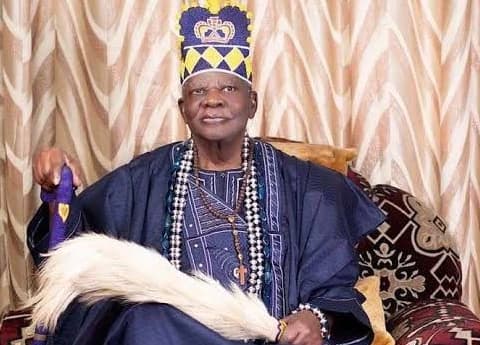
Tributes have continued to pour in following the death of the Paramount Ruler of the Badagry Kingdom and Permanent Vice Chairman of the Lagos State Council of Obas and Chiefs, Oba Babatunde Akran, who passed away on Monday at the age of 89. Lagos State Governor Babajide Sanwo-Olu and former President Olusegun Obasanjo described the monarch’s death as a major loss to Badagry, Lagos State and the country at large.
The passing of the revered traditional ruler, also known as De Wheno Aholu Menu-Toyi I, marks the end of a reign that spanned more than four decades and coincided with significant political, social and economic transitions in Badagry and Lagos State.
Sanwo-Olu describes loss as profound
In a statement issued by his Special Adviser on Media and Publicity, Gboyega Akosile, Governor Sanwo-Olu said Oba Akran’s death had created a deep vacuum in the traditional institution of Lagos State.
According to the governor, the late monarch, who spent nearly 49 years on the throne, was widely respected for his wisdom, commitment to cultural preservation and sustained advocacy for the development of Badagry.
Sanwo-Olu said Oba Akran served his people with dedication and left behind a legacy rooted in unity, tradition and modern development. He described the monarch as a stabilising influence who was able to harmonise diverse interests within the Badagry Kingdom at different periods.
The governor also noted that the royal father played a key role in promoting Badagry’s historical sites and cultural festivals beyond Nigeria’s borders, helping to position the ancient town as a centre of tourism and cultural exchange.
“He also used his position to attract growth and development to the ancient town,” Sanwo-Olu said. “I urge his family, friends, subjects and associates, as well as the entire people of Badagry, whose interests the departed traditional ruler represented and worked tirelessly for during his lifetime, to work towards immortalising him.”
Sanwo-Olu prayed for divine comfort for the royal family and the people of Badagry, describing the loss as irreparable.
Obasanjo recalls monarch as bridge builder
Former President Olusegun Obasanjo also mourned Oba Akran, describing him as an apostle of inter-ethnic cohesion and understanding. Obasanjo said the news of the monarch’s death was received with shock, given his stature among traditional rulers in Lagos State.
In a statement issued by his Special Assistant on Media, Kehinde Akinyemi, Obasanjo said the Akran of Badagry lived a full and impactful life that stretched across eight decades.
“The Akran of Badagry, De Wheno Menu-Toyi, had a most eventful life which traversed eight decades and his reign of about fifty years over the Badagry Kingdom, which occupies a pedestal of looming importance in our ancient and contemporary history, witnessed notable peace and stability,” Obasanjo said.
The former president described Badagry as a repository of Nigeria’s cultural and artistic heritage, noting that Oba Akran served as a custodian of its traditions, customs and values.
According to Obasanjo, the late monarch’s reign was defined by efforts to foster unity, peace and development among the people of Badagry, both at home and in the diaspora.
“The late traditional ruler was an apostle of inter-ethnic understanding and cohesion, inter-religious accommodation and tolerance, and inter-cultural cooperation,” he said.
Obasanjo added that while the loss was deeply painful for the people of Badagry and the royal family, they could draw comfort from the monarch’s enduring legacy and service.
A reign shaped by continuity and change
Oba Babatunde Akran ascended the throne at a time when Badagry was undergoing social and political changes, including its evolving role within Lagos State and Nigeria’s broader national framework. Over the years, he became one of the most prominent voices within the Lagos State Council of Obas and Chiefs, where he served as Permanent Vice Chairman.
Traditional historians note that his long reign provided continuity during periods of uncertainty, including military rule, democratic transitions and rapid urban expansion in Lagos State. Unlike many traditional rulers whose influence waned with modern governance, Oba Akran maintained relevance by engaging government authorities and advocating for community interests.
A Badagry-based cultural historian said the monarch’s background as a journalist contributed to his ability to communicate effectively with both his subjects and government officials.
“He understood the power of dialogue and documentation,” the historian said. “That helped him position Badagry not just as a historical town, but as a living cultural space that still matters in contemporary Nigeria.”
Why his death matters now
Oba Akran’s death comes at a time when traditional institutions are facing renewed scrutiny over their roles in governance, conflict resolution and cultural preservation. In Lagos State, traditional rulers often serve as intermediaries between government and grassroots communities, particularly in matters of land, heritage and social cohesion.
Analysts say the passing of a long-serving monarch like Oba Akran raises questions about succession, continuity and the future direction of traditional leadership in Badagry.
It also underscores the challenge of preserving cultural identity in rapidly urbanising areas. Badagry, despite its historical significance, has faced infrastructure deficits and economic pressures. Oba Akran was among traditional leaders who consistently drew attention to these issues while promoting tourism as a development pathway.
Reactions from Badagry community
Community leaders in Badagry described the monarch’s death as a personal loss. According to local chiefs, Oba Akran was known for his open-door policy and willingness to mediate disputes.
A youth leader in the town said many residents saw the monarch as a symbol of stability.
“He was always there, through different governments and crises,” the leader said. “People trusted his judgement because he listened.”
With the passing of Oba Akran, attention will turn to traditional processes for succession in the Badagry Kingdom. While no official announcement has been made, sources say consultations among kingmakers and royal families are expected to begin in line with established customs.
Observers will also be watching how the Lagos State Council of Obas and Chiefs adjusts to the loss of its Permanent Vice Chairman, given his influence within the body.
The death of Oba Babatunde Akran, the Akran of Badagry, closes a significant chapter in the history of one of Nigeria’s most important ancient towns. Tributes from Governor Babajide Sanwo-Olu and former President Olusegun Obasanjo reflect the breadth of his impact, from grassroots leadership to state and national relevance. As Badagry mourns, the legacy of a monarch remembered for unity, cultural stewardship and nearly five decades of service will continue to shape the kingdom he led.
Add a Comment