


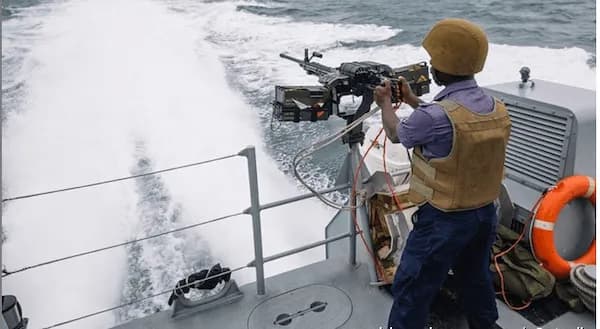
10 March 2026. Calabar. Personnel of the Nigerian Navy arrested two men allegedly impersonating naval officers during an operation conducted by the warship Nigerian Navy Ship Victory, according to an official statement issued on 15 March 2026.
The suspects, identified as Gideon Isaac and David Aleji, were detained on 10 March 2026 by naval personnel attached to Nigerian Navy Ship Victory, the operational unit responsible for maritime security in the Cross River operational sector. Authorities said both men were found dressed in military camouflage and carrying counterfeit identification documents presenting them as serving naval personnel.
They were not sailors.
According to a statement signed by Captain A. A. Folorunsho, Director of Naval Information at the Nigerian Navy, preliminary questioning established that Aleji allegedly presented himself as a Lieutenant in the Nigerian Navy, while Isaac claimed to be a Midshipman assigned to Nigerian Navy Ship Sagbama. Investigators said neither claim corresponded with the Navy’s personnel registry.
The story unraveled quickly.
Naval investigators conducted a search of the suspects’ residence shortly after their arrest. The search yielded several military-style items including a jungle hat, combat boots, and camouflage gear, according to the 15 March 2026 Navy statement issued from Naval Headquarters in Abuja. Authorities also recovered two fabricated military identity cards, which officials say the suspects admitted producing themselves.
One suspect had formal maritime training.
Preliminary findings indicated that Aleji previously attended the Maritime Academy of Nigeria in Oron, Oron, Akwa Ibom State. The academy is Nigeria’s federal institution for maritime education and operates under the supervision of the Federal Ministry of Marine and Blue Economy. Investigators said Aleji allegedly used his familiarity with maritime structures and ranks to create a credible identity as a naval officer.
Related News
Investigators believe he recruited Isaac.
According to the Navy’s preliminary investigation summary dated 15 March 2026, Isaac had been living with Aleji prior to the arrest. Authorities said Aleji allegedly directed the procurement of the camouflage vest, jungle hat, and boots used during the impersonation scheme. Both men reportedly admitted purchasing the items from civilian vendors before fabricating the identification cards.
The case has now moved to civilian law enforcement.
Naval authorities confirmed the suspects were transferred to the Cross River State Police Command for prosecution under Nigeria’s criminal statutes governing impersonation and fraud. While the Navy statement did not cite specific sections of law, impersonating a military officer can fall under Section 132 of the Criminal Code Act, Cap C38, Laws of the Federation of Nigeria 2004, which criminalizes impersonation of public officials.
Conviction carries prison time.
Illegal Oil Storage Destroyed in Rivers State Under Operation Delta Sentinel
The arrests occurred as the Navy continued a parallel anti-bunkering campaign in the Niger Delta. Over the same weekend, naval personnel operating under Operation DELTA SENTINEL dismantled an illegal crude oil storage facility inside the operational jurisdiction of the Forward Operating Base Bonny in Rivers State.
The location was carefully concealed.
According to the same 15 March 2026 statement by Captain Folorunsho, surveillance data obtained through the Navy’s maritime monitoring network led personnel to a cluster of dugout pits hidden beneath dense vegetation within the Opotumbi creek area near Bonny Island. Naval teams deployed from Forward Operating Base Bonny conducted a ground sweep and uncovered four separate pits containing a combined 17,500 litres of petroleum products suspected to be stolen crude oil.
The pits were destroyed immediately.
The Navy said the contents were disposed of in accordance with operational guidelines governing illegal petroleum storage sites. Officials did not disclose whether any suspects were arrested at the Opotumbi location. The statement only confirmed the destruction of the storage pits and the recovered products.
Crude oil theft remains costly.
Nigeria’s losses from illegal bunkering remain significant. Data presented by the Nigerian National Petroleum Company Limited during a Senate briefing on 18 October 2022 recorded 437 illegal refinery sites and 295 illegal pipeline connections discovered within a single operational cycle. The figures were entered into the proceedings of the Nigerian Senate Committee on Petroleum Resources (Upstream).
The numbers show scale.
Security agencies have since expanded coordinated surveillance operations across the Niger Delta. Operation DELTA SENTINEL, launched by the Nigerian Navy in 2024, focuses on maritime patrols, creek monitoring, and destruction of illegal refining infrastructure within coastal states including Rivers State, Bayelsa State, and Delta State.
The campaign continues.
Two men arrested on 10 March 2026 by personnel of the Nigerian Navy Ship Victory allegedly impersonated naval officers using fake identification cards.
Investigators say David Aleji, who attended the Maritime Academy of Nigeria in Oron, allegedly orchestrated the impersonation and recruited Gideon Isaac.
Naval personnel destroyed four illegal crude storage pits containing 17,500 litres of suspected stolen oil in the Opotumbi area near Bonny Island.
Both suspects have been handed to the Cross River State Police Command for investigation under Nigeria’s criminal laws on impersonation.
Why is impersonating a naval officer treated seriously under Nigerian law?
Because the military controls weapons, security zones, and classified information. Section 132 of the Criminal Code criminalizes impersonating public officials, including military officers. The offence can carry prison terms because it threatens national security.
Did the Navy confirm whether the suspects committed other crimes?
Not yet. The 15 March 2026 statement from Naval Headquarters only confirmed impersonation and possession of fake identification cards. Police investigators will determine if fraud, extortion, or other offences occurred.
Why destroy stolen crude oil instead of storing it as evidence?
Operational guidelines used in anti-bunkering missions allow destruction of recovered products when storage poses environmental or security risks. Investigators usually document the seizure first through photographs, inventory records, and patrol reports.
The criminal case now shifts to the Magistrate Court jurisdiction of the Cross River State Police Command, where prosecutors must determine formal charges against Gideon Isaac and David Aleji. Court filings are expected once investigators complete statements and forensic examination of the seized identity cards. The unresolved question is whether prosecutors will pursue only impersonation charges under the Criminal Code or add fraud counts tied to any financial benefit the suspects may have obtained while posing as officers. The charge sheet will answer that.
Add a Comment