


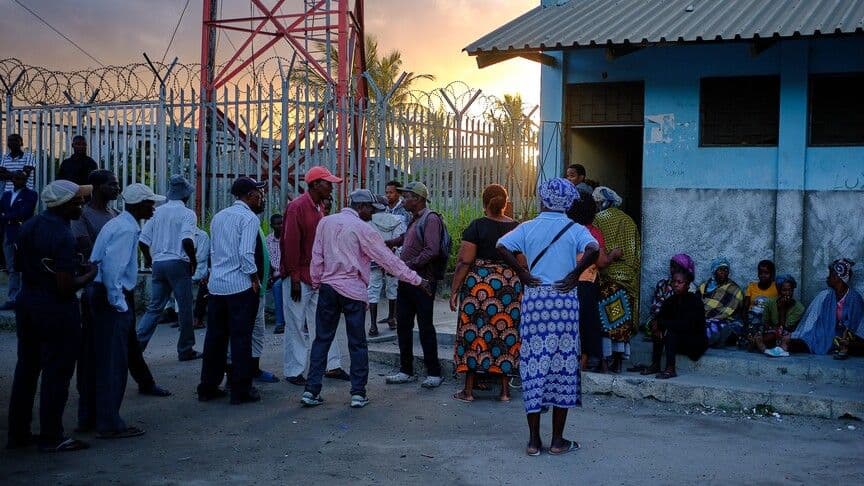
Mozambique says 800 of its citizens were caught up in violence in Mossel Bay, and five were killed in what it described as xenophobic attacks.
The Mozambican government says another two citizens died in a road accident while returning home from South Africa.
South African police have confirmed investigations into two deaths in Mossel Bay but have not publicly linked them to anti-migrant protests.
The latest unrest comes months before South Africa's November local government elections, when immigration has become a prominent political issue.
Seven Mozambican citizens are dead after violence erupted in the South African coastal city of Mossel Bay, according to a statement issued Tuesday by the Mozambican government.
The government said five of the deaths resulted directly from what it described as xenophobic attacks. Two others, it said, died in a road accident while traveling back to Mozambique after fleeing the unrest.
The figures immediately elevated the incident from a local disturbance to a diplomatic concern involving two neighboring countries.
According to the Mozambican statement, approximately 800 Mozambican nationals were caught up in violence that began in Mossel Bay on Friday. Authorities said about 300 returned to Mozambique on Saturday, while roughly 500 remained under protection in South Africa's Western Cape Province pending repatriation efforts.
Related News
Those numbers provide the first official indication of the scale of displacement caused by the unrest.
The Mozambican government's account places responsibility for five deaths on xenophobic violence directed at foreign nationals.
In its statement, authorities said the victims were among hundreds of Mozambicans affected by attacks that broke out in the coastal municipality. Officials also stated that the remaining 500 citizens were relocated to a secure location in the Western Cape and were expected to be repatriated on Tuesday.
Five deaths were attributed to violence. Two were linked to a traffic accident involving Mozambicans attempting to return home.
The distinction is important because it separates fatalities allegedly caused by attacks from those occurring during the broader displacement process.
Mozambican authorities have not publicly released the names of the deceased or provided a detailed chronology of the incidents leading to their deaths. No public documentation identifying the precise circumstances of each killing had been released at the time of reporting.
South African Authorities Have Not Confirmed the Xenophobia Claim
While Mozambique has described the violence as xenophobic, South African authorities have taken a more cautious public position.
On Sunday, South African police confirmed they were investigating the deaths of two men at an informal settlement in Mossel Bay. Police statements did not identify the men, disclose their nationalities, or publicly connect the deaths to anti-immigrant demonstrations.
At present, the public positions of the two governments differ in scope. Mozambique has explicitly characterized the attacks as xenophobic and linked five deaths to them. South African police have acknowledged deaths under investigation but have not publicly confirmed the motive or circumstances.
The discrepancy does not necessarily represent a contradiction. It reflects different stages of official reporting and investigation.
A Familiar Pattern in South Africa
The Mossel Bay violence has renewed attention on a problem South Africa has confronted repeatedly for nearly two decades.
Waves of anti-foreigner violence have recurred since 2008, affecting migrants from countries including Mozambique, Zimbabwe, Malawi, Somalia and Ethiopia. Previous outbreaks have resulted in deaths, property destruction and large-scale displacement.
The current unrest is unfolding against a backdrop of national protests focused on undocumented immigration. Demonstrators in several parts of South Africa have argued that illegal immigration places pressure on employment opportunities, housing and public services.
Those claims remain politically influential.
Yet migrant advocacy organizations and human rights groups have long argued that such narratives can contribute to hostility toward foreign nationals, particularly in economically vulnerable communities where competition for resources is perceived to be intense.
The latest spike in anti-migrant activism comes as South Africa prepares for local government elections scheduled for November.
Election periods often increase scrutiny of immigration policy because political parties and activist groups seek to mobilize voters around issues with strong public resonance. Immigration has increasingly become one of those issues.
The reality is that immigration has moved from being primarily a policy discussion to becoming a recurring feature of political campaigning and public demonstrations. That shift has been documented through repeated protests targeting undocumented migrants in multiple provinces over recent years.
Our analysis of official statements released by Mozambican authorities shows that all 800 affected citizens referenced in Tuesday's announcement were linked to a single outbreak of violence in Mossel Bay. That concentration highlights how quickly local unrest can produce regional diplomatic consequences.
Mozambique and South Africa maintain extensive economic and migration ties. Thousands of Mozambicans work, study or conduct business in South Africa, making the treatment of migrant communities a matter of continuing bilateral interest.
The Human Cost Behind the Numbers
Statistics often obscure the immediate consequences of violence.
The Mozambican government's figures indicate that 300 people left South Africa within a day of the unrest beginning. Another 500 required temporary shelter and organized repatriation arrangements.
Families are separated. Employment is interrupted. Individuals who crossed borders seeking economic opportunities suddenly find themselves dependent on emergency assistance and government intervention.
The available information does not establish how many of the displaced intend to return to South Africa once conditions stabilize. Nor does it clarify whether homes, businesses or personal property were damaged during the unrest.
Has South Africa confirmed that five Mozambicans were killed?
No. Mozambique has publicly stated that five citizens were killed in xenophobic attacks. South African police have confirmed investigations into two deaths but have not publicly linked them to anti-migrant violence.
Why were 800 Mozambicans affected?
According to the Mozambican government, about 800 citizens were caught up in violence that erupted in Mossel Bay on Friday. Authorities have not yet released a full breakdown of where all affected individuals were located.
Is this connected to South Africa's elections?
The timing overlaps with preparations for November local government elections. Immigration has become a prominent political issue, but authorities have not formally linked the Mossel Bay violence to any election campaign activity.
The next unresolved question is whether South African investigators will formally determine that the deaths were motivated by xenophobia. Any resulting criminal proceedings would likely begin in a South African magistrate's court with jurisdiction over Mossel Bay. No charging deadline has been announced, no compensation figure has been disclosed, and the central right still in dispute is whether migrant residents can live and work without being targeted because of their nationality.
Add a Comment