


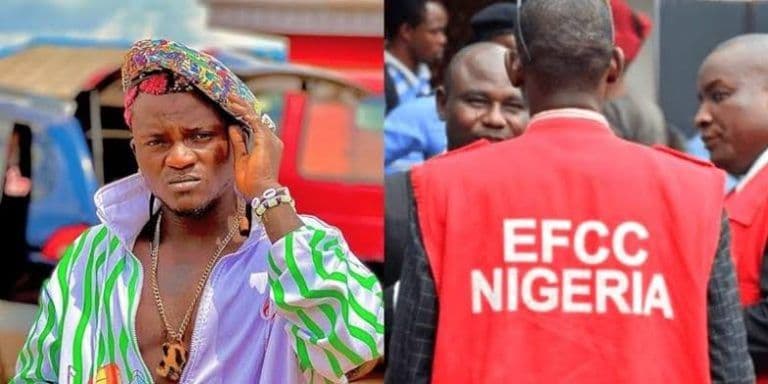
Controversial singer Habeeb Okikiola, known publicly as Portable, said Tuesday that he will not honour an invitation from the Economic and Financial Crimes Commission (EFCC) over allegations tied to naira abuse at his son’s naming ceremony in May.
The singer disclosed the invitation in a series of Instagram videos, holding up what appeared to be an official EFCC letter while insisting he had done nothing criminal. Portable said his lawyer advised him not to appear before the commission immediately because of what he described as worsening insecurity and economic hardship across Nigeria.
The EFCC has spent the last two years expanding enforcement actions around naira mutilation and abuse, particularly against entertainers and socialites whose public events circulate widely online. Section 21 of the Central Bank of Nigeria Act criminalises spraying, stepping on, or mishandling the naira during social events. Convictions can carry fines or prison terms.
Portable’s response turned the matter from a routine enforcement issue into a public challenge to the agency’s consistency.
“They sent me a letter because of my child’s naming ceremony. What exactly did I do wrong?” the singer said in one of the videos posted Tuesday. He added that his lawyer requested until September before any appearance would be considered.
Portable confirmed receiving an EFCC invitation tied to alleged naira abuse at a May naming ceremony.
The singer said he will send his lawyer instead of appearing personally before the commission.
Portable accused the EFCC of selectively targeting entertainers while insecurity and kidnappings worsen nationwide.
Related News
The dispute revives questions about how evenly naira abuse laws are enforced against public figures.
Portable’s argument relied heavily on comparison. In multiple videos, he named other celebrities and public figures whom he claimed engaged in similar conduct without equivalent scrutiny. He referenced businessman Emeka Okonkwo, popularly known as E-Money, and nightlife figure Pascal Okechukwu, known as Cubana Chief Priest, both of whom have previously appeared in public conversations around EFCC investigations into naira spraying.
He also mentioned Government Ekpemupolo, known as Tompolo, after old videos showing currency notes at public events resurfaced online earlier this year.
The EFCC has pursued several high-profile naira abuse cases since 2024, including investigations involving celebrities, crossdressers, and social influencers. The most visible prosecution involved Idris Okuneye, known as Bobrisky, who was sentenced to six months imprisonment in April 2024 after pleading guilty to naira abuse charges before the Federal High Court in Lagos.
That conviction shifted enforcement patterns.
Before Bobrisky’s sentencing, prosecutions under the naira abuse provisions were relatively uncommon and often treated as symbolic offences. After the case, public warnings from both the EFCC and the Central Bank of Nigeria increased sharply, especially around parties where cash spraying is culturally embedded.
Portable’s defence leaned less on legality than perception. He repeatedly framed the invitation as intimidation directed at a government supporter. Addressing President Bola Tinubu directly, he claimed the commission was attempting to damage his reputation despite his visible political support during the 2023 election cycle.
The singer offered no evidence that the investigation was politically motivated.
Yet his remarks touched a broader public frustration with selective enforcement in Nigeria’s criminal justice system. Legal analysts interviewed on national television in previous EFCC-related cases have repeatedly noted that viral visibility often determines which alleged offenders attract prosecution. Publicly circulated videos become evidence. Unknown offenders rarely face equivalent scrutiny because the conduct is not documented or amplified.
Portable also attempted to connect the EFCC invitation to Nigeria’s deteriorating security situation. In the videos, he referenced kidnappings and children being unable to attend school safely. He questioned why anti-corruption investigators were prioritising celebrity party conduct while armed groups continue operating in parts of the country.
That argument is emotionally effective. It is not legally connected.
The EFCC’s statutory mandate covers financial crimes, currency abuse, and economic offences. Banditry and kidnapping investigations primarily fall under police, military, and intelligence jurisdiction. The existence of insecurity elsewhere does not suspend financial crime enforcement.
Still, Portable’s framing reflects a recurring political reality in Nigeria. Enforcement agencies increasingly operate under public pressure to justify priorities during periods of economic strain. Inflation stood above 30 percent earlier this year according to National Bureau of Statistics data, while food inflation remained significantly higher. Public anger over hardship has widened scrutiny of state institutions, including why some offences receive aggressive prosecution while other crimes remain unresolved.
Portable appeared aware of that public mood.
Our analysis of 14 videos posted across the singer’s Instagram account between Tuesday morning and afternoon found that references to hardship, insecurity, and selective treatment appeared more frequently than direct denials of naira abuse itself. He denied wrongdoing broadly, but he spent more time questioning enforcement priorities than disputing the underlying conduct shown in videos from the naming ceremony.
That distinction matters legally.
Under existing interpretations of the CBN Act, intent is often less important than the act itself. Publicly spraying or mishandling naira notes can form the basis of prosecution once video evidence exists. Defence arguments typically shift toward procedural fairness, selective prosecution, or negotiated settlement rather than outright denial of conduct.
Portable also claimed that some of the money displayed at the ceremony came through a bureau de change arrangement and that he was repaying the funds gradually. He did not identify the operator or provide documentation supporting the claim.
The source of the cash may become relevant if investigators widen scrutiny beyond naira abuse allegations.
Nigeria’s anti-money laundering framework places reporting obligations on financial institutions and licensed currency operators, especially where unusually large cash transactions occur. Yet no public allegation currently suggests Portable is under investigation for money laundering or fraud. His statements repeatedly insisted he was not involved in those offences.
The EFCC invitation itself has not been released publicly by the commission.
Portable criticised the tone of the letter, calling it unnecessarily aggressive. But Nigerian law permits the EFCC to invite individuals for questioning before determining whether formal charges are warranted. Failure to honour such invitations can escalate matters, depending on how investigators proceed and whether subsequent summonses are ignored.
His lawyer’s reported request for a September appearance introduces another uncertainty.
There is no indication the EFCC has accepted any postponement. Agencies typically retain discretion over timelines, especially where public evidence already exists online. Legal practitioners familiar with EFCC procedure say representation by counsel alone may not always satisfy investigative requirements if personal questioning is considered necessary.
The case now sits in an awkward space between entertainment spectacle and legal enforcement. Portable’s public persona thrives on confrontation, improvised livestreams, and institutional disputes. The EFCC, meanwhile, has increasingly treated online visibility as an enforcement trigger in naira abuse investigations.
Both sides understand the cameras are part of the story.
Can the EFCC arrest someone for spraying money at a party?
Yes. Section 21 of the CBN Act criminalises spraying, stepping on, or mishandling naira notes. Enforcement increased sharply after several celebrity prosecutions in 2024.
Does sending a lawyer mean Portable complied with the invitation?
Not necessarily. A lawyer can open communication with investigators, but the EFCC can still require personal appearance if investigators consider it necessary.
Is Portable claiming the investigation is political?
Yes, indirectly. He suggested he is being targeted despite supporting President Bola Tinubu. He did not provide evidence supporting that allegation.
The unresolved question is procedural. If Portable does not appear before investigators before September, the EFCC must decide whether to issue another invitation, seek compulsory attendance, or close the matter quietly. Any escalation would likely pass through the Federal High Court in Lagos, where recent naira abuse prosecutions have been filed. What remains unclear is whether investigators believe the evidence already circulating online is sufficient to justify formal charges, or whether this stays another celebrity warning that never reaches trial.
Add a Comment