


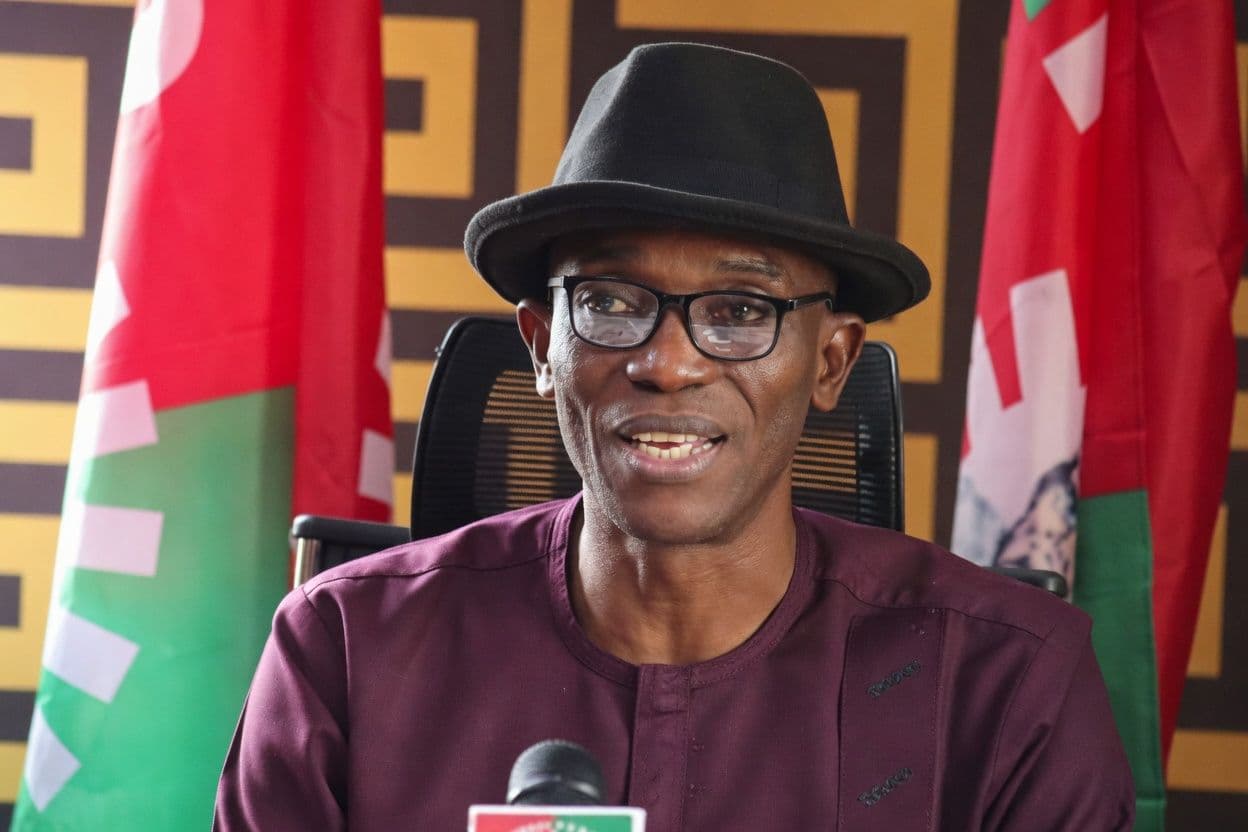
The Labour Party fixed May 27 and May 29, 2026 for primaries despite an Appeal Court judgement challenging the legitimacy of its leadership structure. That decision, announced Monday by factional chairman Julius Abure, pushes Nigeria’s third-force opposition party deeper into a legal contest that now sits before the Supreme Court.
The dispute is no longer internal.
At stake is whether candidates emerging from Abure’s faction can survive legal scrutiny ahead of the 2027 general elections. The answer may determine whether the party that produced one of the country’s strongest opposition showings in 2023 can remain electorally viable or descend into years of litigation.
Abure said his faction had already filed a notice of appeal against the January 21, 2026 Appeal Court ruling and was waiting for records to be compiled before submitting its brief to the Supreme Court. He did not disclose the suit number or the timeline for hearing.
Appeal Court Ruling Leaves Labour Party Structure in Dispute
The January 21 judgement struck directly at the authority claimed by Abure’s National Working Committee. In Monday’s statement, he insisted the current leadership emerged from the Labour Party’s March 27, 2024 national convention in Nnewi, Anambra State, and said the convention was recognised by the Independent National Electoral Commission.
According to Abure, INEC later reversed its position and declared the tenure of the executives expired. He described the regulator’s action as a “volte-face”.
The timeline raises a procedural problem.
Related News
Under Nigeria’s Electoral Act, disputes over party leadership often spill into candidate nomination battles. Courts have repeatedly ruled that political parties must comply with their constitutions and properly notify INEC before congresses or conventions. A leadership body later deemed invalid can expose candidate nominations to legal challenge.
Abure’s statement suggested his faction intends to proceed regardless of unresolved litigation. He announced governorship and state assembly primaries for May 27, while House of Representatives and Senate primaries are fixed for May 29.
He also said the party’s presidential candidate for 2027 would emerge through a consensus process in Abuja on the same day.
Major Nigerian parties rarely finalise presidential selection structures this far ahead of a general election cycle. The move appears designed to establish operational control before the Supreme Court delivers a final ruling.
Nenadi Usman Faction and INEC Notifications Become Central Dispute
Abure directly attacked the rival bloc led by Nenadi Usman, arguing that notices sent to INEC by her faction lacked legal standing because only the party’s National Executive Committee could authorise congresses and primaries.
That claim points to the core institutional fight.
Who controls the recognised NEC effectively controls candidate lists, convention authority, delegates and party assets. Nigerian courts have historically treated those questions as determinative in intra-party disputes.
Our analysis of Abure’s statement found repeated references to legitimacy through procedure rather than ideology. He mentioned conventions, notices, congresses and primaries at least nine times. He mentioned policy only once, in reference to free nomination forms.
The emphasis is revealing.
The Labour Party’s internal crisis has increasingly shifted from electoral messaging to control of legal instruments and party machinery. That transition mirrors earlier factional battles inside the People's Democratic Party and the All Progressives Congress, where competing court orders and rival executives paralysed state chapters before national interventions restored order.
Yet Labour Party’s situation is narrower financially and structurally. The party lacks the patronage network and institutional reserves that larger parties used to survive prolonged litigation.
Free Nomination Forms Raise Questions About Funding and Candidate Screening
Abure announced that nomination forms for all positions would be distributed free through party online platforms and state chairmen. He framed the policy as ideological, saying it would allow candidates without substantial financial resources to contest elections.
He cited the 2022 and 2023 election cycle as precedent.
According to him, the policy helped produce lawmakers from lower-income backgrounds, including “Okada riders and palm kernel crushers.” The statement appears intended to reinforce Labour Party’s anti-establishment identity, particularly after the party’s strong urban youth mobilisation in 2023.
But the financing model remains unclear.
Political parties traditionally rely on nomination fees to fund congresses, litigation, logistics and campaign infrastructure. Larger Nigerian parties have generated billions of naira from presidential and governorship forms alone during past election cycles.
Labour Party’s alternative funding structure has not been publicly detailed.
We reviewed publicly available Labour Party financial disclosures filed after the 2023 elections. The filings contained no comprehensive explanation of how the party would sustain nationwide primaries without substantial nomination revenue. The current factional split is also likely to increase legal costs through parallel suits in multiple jurisdictions.
That pressure is growing.
Alex Otti Reconciliation Talks Expose Wider Breakdown
Abure also addressed allegations involving Alex Otti, denying reports that party officials demanded money during reconciliation discussions.
He said talks focused on power-sharing and reconciliation but collapsed after Otti allegedly demanded dissolution of existing party structures.
Neither side released documentary evidence from those meetings.
Still, the public disagreement signals how far relations have deteriorated between the party leadership and one of its most electorally successful governors. Otti remains among Labour Party’s highest-profile officeholders after the 2023 elections, giving the dispute significance beyond internal party procedure.
Abure framed the conflict as retaliation linked to Labour Party’s 2023 performance. He alleged that individuals who benefited from the party’s electoral gains were now destabilising it from within.
Without supporting documents or identifiable actors, the allegation remains political positioning rather than verifiable fact. Yet the statement reflects a broader pattern in Nigerian opposition politics, where post-election coalition fractures often emerge once access to offices, appointments and party structures becomes contested.
Julius Abure is proceeding with 2027 primaries even though the legitimacy of his leadership remains before the Supreme Court.
The fight between Abure’s faction and Nenadi Usman is fundamentally about who controls party structures and candidate nominations.
Labour Party says nomination forms will be free nationwide, but the party has not publicly explained how it will fund large-scale primaries and litigation simultaneously.
The breakdown in reconciliation talks with Alex Otti suggests the dispute now involves senior elected officials, not just party administrators.
Can Labour Party still field candidates while the case is in court?
Yes. Political parties often continue activities during litigation. But candidates produced by a faction later ruled illegitimate can face court challenges to their nominations.
Why does INEC recognition matter so much?
Because INEC recognition affects which executives can officially submit candidate names, hold congresses and communicate legally for the party. Courts often examine those records closely.
Does the Supreme Court usually resolve these disputes quickly?
Not always. Some intra-party cases drag on for months or longer, especially when appeals involve convention validity, executive tenure and competing interpretations of party constitutions.
The unresolved question is whether the Supreme Court will affirm the January 21 Appeal Court decision before Labour Party finalises candidate lists for 2027. If the ruling goes against Abure’s faction after primaries are conducted, the legality of nominations submitted to Independent National Electoral Commission could become the next contested issue, alongside control of party structures and any financial obligations tied to parallel congresses already underway.
Add a Comment