


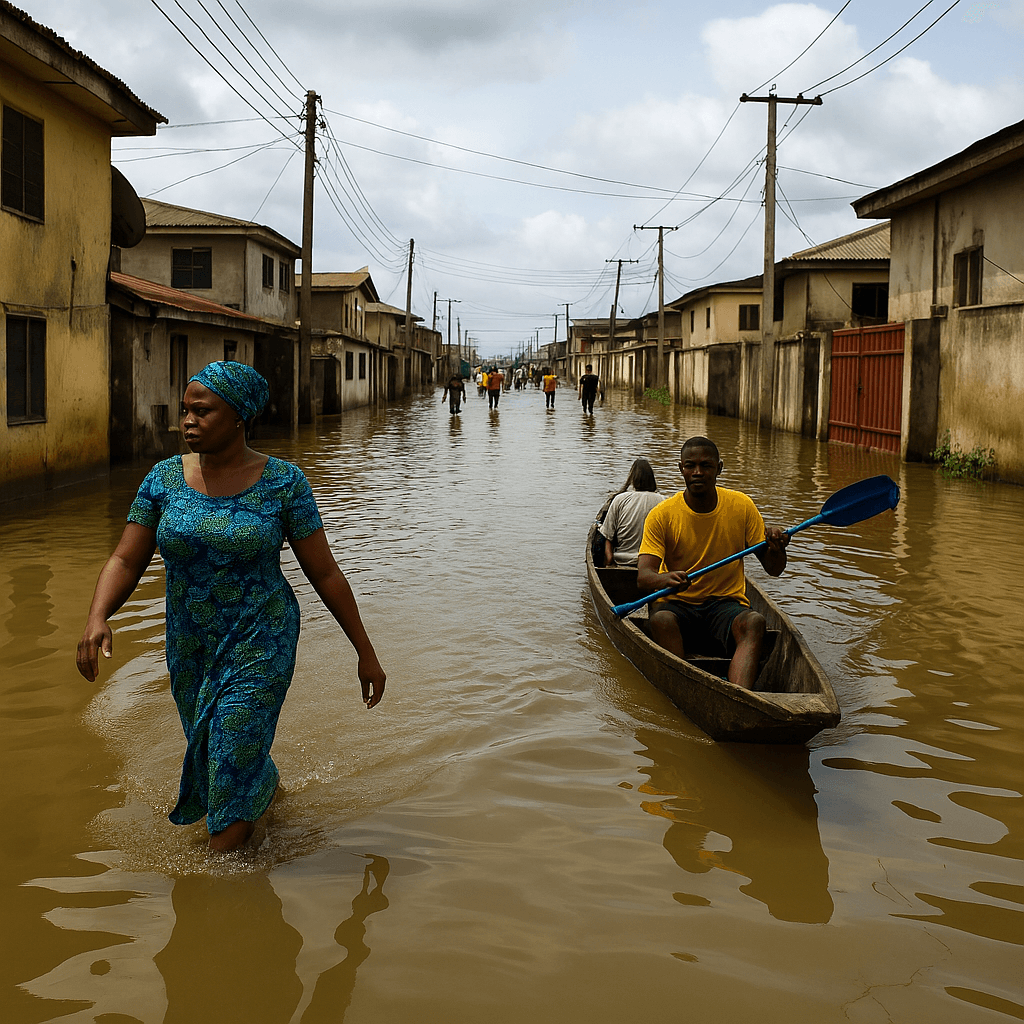
Lagos, Nigeria’s commercial centre and one of Africa’s fastest growing urban regions, now confronts a climate test many residents once thought distant. Flooding, once brief and seasonal, has become deeper, longer lasting, and more disruptive. For millions, the rains bring more than damp streets. They bring broken livelihoods, damaged homes, and public health risks that extend well beyond the immediate water levels.
This growing problem has pushed state officials, scientists, and community leaders into new collaborations designed to strengthen the city’s resilience. But whether these efforts will be enough remains a subject of debate among planners and residents alike.
Geography, Growth, and Changing Weather
Lagos’ modern flood problem has three key roots: its geography, its rapid growth, and changes in rainfall patterns.
Geographically, much of metropolitan Lagos lies just a few metres above sea level. Coastal experts, including researchers from the Nigerian Institute of Oceanography, note that this makes the city especially vulnerable to both heavy rainfall and storm surges. The city’s lagoon shoreline and shallow creeks can hold floodwater long after the rain stops.
At the same time, Lagos continues to grow at a pace few cities can match. The most recent population estimate from Nigeria’s National Population Commission puts the city’s population at more than 20 million people. Urban sprawl has crept into areas that once acted as natural buffers against flooding, such as wetlands and marshes. Development now fills these buffers, reducing the land’s capacity to absorb heavy rains.
Rainfall itself has also changed. Data from the Nigerian Meteorological Agency shows that while total annual rainfall in Lagos has not increased dramatically, intense rainfall events have become more frequent over the past decade. This pattern floods streets faster than drainage systems can handle and overwhelms traditional infrastructure.
Residents feel these changes firsthand. Local health officials in the Kosofe and Surulere areas have reported increases in cases of waterborne illness following flood events in recent years, a pattern consistent with World Health Organization observations on climate-related health effects.
A Nine Billion Dollar Resilience Plan Takes Shape
In 2026, the Lagos State Government unveiled what it described as a landmark climate resilience plan. Officials presented the strategy as one of the largest subnational investments in environmental risk mitigation in Africa.
Related News
State authorities told local media that the plan would channel approximately 9 billion dollars into actions that include expanding and maintaining major drainage canals, strengthening flood barriers in the most vulnerable neighbourhoods, and integrating climate considerations into the city’s urban planning codes.
Officials have placed particular emphasis on waste management. Blocked drainage channels, clogged with plastic and other debris, are widely acknowledged as among the most frequent direct causes of flooding in built-up areas. To combat this, the resilience plan includes so-called waste-to-wealth programmes designed to encourage recycling and reduce informal dumping.
Local Efforts and Research Partnerships
Statewide plans are not the only initiatives underway. Some local councils are experimenting with problem-specific responses rooted in community realities.
Agboyi-Ketu Local Council Development Area, for example, has partnered with the African Cities Research Consortium (ACRC) to co-design flood resilience methods specific to Ajegunle-Ikorodu, one of the city’s most flood-affected corridors. In interviews, ACRC analysts said their goal was to merge scientific mapping of flood pathways with lived experience from residents, producing low-cost models that might be expanded to other settlements.
These pilot efforts include community mapping of where floods rise first, outreach to local residents about early warning actions, and small-scale tests of flood-adapted infrastructure such as permeable ground surfaces that help water soak in more slowly.
Such approaches reflect a broader insight shared by urban development specialists: top-down infrastructure alone will fail unless it connects with community behaviour and local knowledge.
What Is Being Done on the Ground
Across Lagos, several measurable interventions are currently underway.
Drainage upgrades continue in key thoroughfares and residential districts. According to official project logs published by the Lagos State Ministry of Environment, cleaning and expansion of canals is ongoing in more than 15 major zones.
Urban planners have said they are tightening building oversight, particularly near waterways and in designated high-risk zones. Enforcement has historically been uneven, but climate vulnerability assessments now form part of approval checklists for new construction.
At the grassroots level, neighbourhood groups and non-governmental organisations are leading preparedness workshops. These sessions teach residents how to secure property documents ahead of storms, respond to evacuation alerts, and manage waste so drains stay clear.
Nature-based solutions are also part of the strategy. Lagos City Council reports that pilot projects restoring degraded wetlands and creating small urban green spaces are underway in districts such as Mushin and Ikoyi. Officials say these green areas are intended to act as living water buffers that reduce the speed and volume of runoff.
Hurdles Still Ahead
Despite these efforts, serious challenges remain.
Financing is a perennial concern. Large infrastructure investments like canal expansion and sea barriers require long-term funding streams beyond yearly budget cycles. Financial analysts familiar with Lagos’ planning process say that economic pressures could push parts of the resilience plan into the next decade.
Enforcement of urban planning codes also remains uneven. Illegal construction and unchecked waste dumping still undermine drainage improvements in older communities. In focus group discussions with neighbourhood leaders, residents identified compliance as a major fracture point between policy ambitions and lived reality.
Equity concerns are also acute. Informal settlements, which are often most exposed to flooding, typically have the least access to formal services and the weakest financial cushions when disaster strikes. Climate vulnerability experts have emphasised that resilience planning must explicitly prioritise these communities if it is to avoid deepening existing social disparities.
A Broader Perspective
Climate and urban experts from around West Africa have noted that Lagos’ situation is not unique. Cities such as Accra, Abidjan, and Dakar face similar combinations of rapid urban growth, coastal vulnerability, and outdated infrastructure.
According to Dr Tunji Ogunyemi, a lecturer in urban resilience at the University of Lagos, Lagos’ new planning efforts could serve as a template for other cities in the region if they prove durable and inclusive. In his view, the emphasis on community partnerships and data-informed planning sets a new standard for municipal climate responses.
The risk of flooding in Lagos is no longer a once-a-year inconvenience. It is a structural challenge linked to climate change, rapid growth, and long-deferred infrastructure investment. The strategies now in motion reflect a more comprehensive approach, blending physical infrastructure, community engagement, and long-term policy planning.
Whether these actions will keep Lagos afloat through future climate shocks is not yet certain. What is clear is that the city is no longer reacting after floods happen. Instead it is attempting to plan ahead in ways that may influence urban climate resilience across West Africa.
Add a Comment