


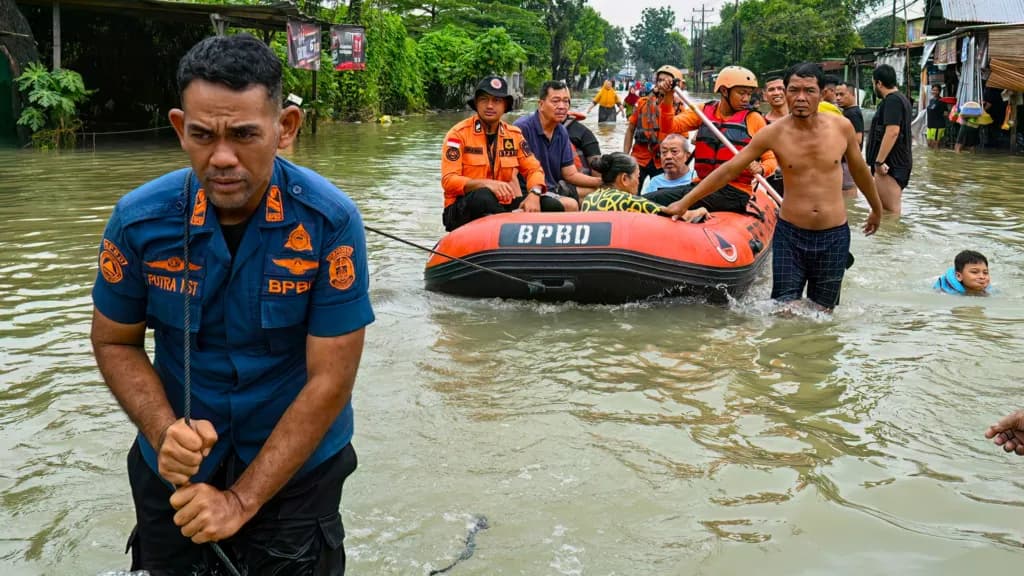
More than 440 people have been confirmed dead after days of severe flooding and landslides tore through Indonesia’s Sumatra island, according to emergency officials. The toll, which hovered above 300 earlier on Sunday, surged as rescue teams reached previously inaccessible areas cut off by rising waters and blocked roads.
Rising death toll amid widespread destruction
Rescue workers are still struggling to reach communities where electricity and mobile networks remain only partially restored. According to Indonesia’s disaster management agency, tens of thousands of people have been evacuated, but hundreds more remain trapped by debris, fast-moving water, and damaged roads.
The flooding, fuelled by unusually intense monsoon rains and a series of tropical storms, has produced one of the region’s worst natural disasters in recent years. Malaysia and Thailand have also reported heavy casualties, while millions across Southeast Asia are dealing with submerged homes, power outages, and food shortages.
According to Thai authorities, at least 170 people have died there, and two additional deaths were recorded in northern Malaysia’s Perlis state.
Meanwhile, Sri Lanka has reported nearly 160 deaths caused by days of torrential rain and mudslides.
Cyclone Senyar triggers deadly landslides in Indonesia
In Indonesia, the devastation has been linked to Cyclone Senyar, a storm meteorologists describe as exceptionally rare for the Malacca Strait. The cyclone unleashed sudden landslides, washed away homes, and left thousands of structures buried or underwater.
“The water came so quickly. In seconds it was already in the streets and entering houses,” Arini Amalia, a resident of Aceh Province, told the BBC. She and her grandmother managed to escape to higher ground, but when she returned the next day, her home had disappeared beneath the flood. “It’s already sunk,” she said.
Another resident, Meri Osman from West Sumatra, said he was “swept away by the current” and survived only by clinging to a clothesline until rescuers arrived.
Related News
“Everything was gone,” a man from Bireuen, also in Aceh, told Reuters. “I wanted to save my clothes, but my house collapsed.”
Authorities say Tapanuli has suffered some of the worst destruction. Local officials reported that desperate residents broke into shops searching for food as supplies dwindled.
Humanitarian groups inside the country are urging Jakarta to declare a national disaster, which would allow aid agencies to mobilize more personnel and funding.
Thailand records some of its deadliest floods in a decade
In southern Thailand, water levels rose as high as three meters in Songkhla province, killing at least 145 people. According to the government, more than 3.8 million residents across 10 provinces have been affected.
The city of Hat Yai endured 335 millimeters of rainfall in one day last week, a record officials say has not been seen in more than 300 years. As floodwaters receded, the death toll climbed sharply. AFP reported that one overstretched hospital was forced to store bodies in refrigerated trucks after its morgue reached capacity.
Thanita Khiawhom, a resident of Hat Yai, told BBC Thai that no assistance reached her neighborhood for a week. “We were stuck in the water for seven days and no agency came to help,” she said.
Thai authorities have announced financial support for affected families, including compensation of up to two million baht, or about sixty-two thousand dollars, for households that have lost loved ones.
Malaysia and Sri Lanka also hit hard
Although Malaysia’s death toll remains comparatively low, flooding has left large sections of Perlis state underwater. Tens of thousands of people have sought shelter in evacuation centers as authorities continue to monitor rising river levels.
In Sri Lanka, Cyclone Ditwah has brought the worst weather disaster in years. According to the Disaster Management Centre, at least 193 people have been killed and more than 200 others are still missing. The government has declared a state of emergency as rescue teams battle to reach flooded communities.
More than 15,000 homes have been destroyed, officials said, and roughly one-third of the country is without electricity or running water.
Meteorologists warn of unusual storm patterns
Weather experts say the severe conditions across Southeast Asia could be linked to the interaction between Typhoon Koto, which has moved across the Philippines and is heading toward Vietnam, and the unexpected formation of Cyclone Senyar.
AFP reported that three people in Vietnam have already died due to the effects of Typhoon Koto, with one individual still missing.
Although scientists caution that individual storms cannot be directly attributed to climate change, they note that global warming is making extreme weather events more frequent and intense. Heavier rainfall, sudden flash floods, and stronger winds are now more common across the tropics, according to climatologists interviewed by regional media outlets.
A region bracing for more rain
Southeast Asia’s monsoon season, which typically runs from June to September, often brings heavy downpours. This year, however, the combination of multiple overlapping storm systems has resulted in widespread devastation.
Disaster experts say recovery could take months, particularly in rural areas where roads, bridges, and farmland have been destroyed. Humanitarian groups are calling for increased international support as the death toll continues to rise.
Add a Comment