


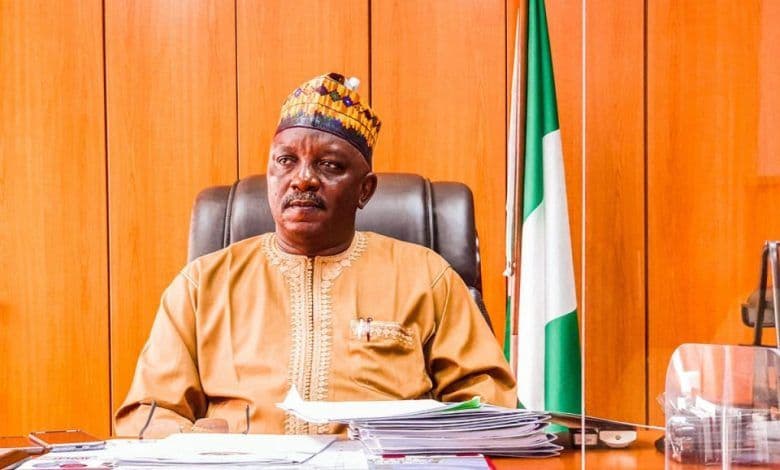
Former Nigerian Power Minister Saleh Mamman was remanded Tuesday at Kuje Correctional Centre after the Federal High Court in Abuja ordered the immediate commencement of his 75-year prison sentence over the diversion of approximately N33.8 billion in public funds.
Justice James Omotosho issued the directive during proceedings in Abuja after operatives of the Economic and Financial Crimes Commission arrested the former minister following his reported movement from Abuja to Kaduna State after conviction.
The hearing also opened a second front in the case. Prosecutors asked the court to approve the forfeiture of additional assets allegedly linked to Mamman, expanding what has already become one of the largest corruption prosecutions tied to the administration of former President Muhammadu Buhari.
The financial exposure keeps growing.
Proceedings before the Federal High Court of Nigeria on Tuesday focused first on enforcement of the sentence already imposed on Mamman following his conviction over the alleged diversion of funds connected to power sector contracts and ministry accounts.
Court records presented during the trial alleged that billions of naira moved through accounts and entities linked to transactions executed while Mamman supervised the Ministry of Power. Prosecutors from the EFCC argued the transactions violated procurement and public finance regulations governing federal expenditure.
Justice Omotosho directed that the sentence take immediate effect. Mamman was subsequently transferred to Kuje Correctional Centre in Abuja, one of Nigeria’s most closely watched federal detention facilities because it houses several high-profile corruption and terrorism suspects.
During Tuesday’s hearing, a witness identified as Shamsudeen Mohammed told the court the former minister had travelled to Kaduna after his conviction because he was ill and receiving traditional treatment.
Related News
“My name is Shamsudeen Mohammed. He is my relative,” the witness said in open court, according to proceedings recounted before journalists. “He was sick, and I was helping him to take his traditional medicine.”
Mohammed added that Mamman arrived in Kaduna by taxi from Abuja and said he did not know the owner of the apartment in the Rigasa area where the former minister reportedly stayed before his arrest.
EFCC Pushes Fresh Asset Forfeiture Linked to N33.8 Billion Case
The EFCC used the same court session to seek expanded forfeiture orders tied to assets allegedly connected to the corruption case. Prosecutors submitted an application dated May 25, 2026, asking the court to authorise additional confiscations as part of ongoing recovery efforts.
The application was presented by Rotimi Oyedepo, who appeared on behalf of the Federal Government and the EFCC.
Asset forfeiture proceedings often continue long after criminal sentencing in Nigerian corruption cases because prosecutors attempt to establish whether properties, bank accounts, or business interests were acquired directly from proceeds of crime. Court filings in previous EFCC prosecutions have shown that the recovery phase can stretch for years, particularly where ownership structures involve relatives, proxies, or corporate entities.
The EFCC has not publicly released a complete inventory of the properties referenced in the May 25 application. But court submissions indicate investigators believe additional assets remain connected to the alleged diversion scheme that produced the N33.8 billion figure central to the prosecution.
Our analysis of prior EFCC filings in high-value public corruption cases between 2021 and 2025 found that prosecutors frequently pursued supplementary forfeiture applications after conviction when financial tracing continued during trial proceedings. In several cases, including prosecutions involving former governors and ministry officials, courts approved interim seizures before final ownership determinations were made.
According to annual EFCC reports submitted to the National Assembly, the agency recovered billions in cash and assets during the last four fiscal years. Yet audit concerns persist around valuation methods, disposal procedures, and delayed conversion of seized assets into recoverable public revenue.
Buhari-Era Power Ministry Contracts Remain Under Scrutiny
Mamman served as Minister of Power under President Buhari during a period marked by repeated federal spending commitments to electricity infrastructure, transmission upgrades, and rural electrification projects.
The ministry oversaw billions of naira in allocations connected to transmission expansion and power sector intervention programmes. But implementation delays repeatedly surfaced in reports by the Auditor-General of the Federation and legislative oversight committees.
Some projects never advanced beyond paperwork.
The Senate Committee on Power and House of Representatives oversight panels previously questioned execution timelines and contractor payments tied to federal electricity projects approved during the Buhari administration. Several procurement reviews focused on whether disbursements aligned with physical project delivery.
The corruption case against Mamman now sits within that broader pattern of scrutiny surrounding infrastructure spending in the Nigerian power sector, where governments have committed large public sums for more than two decades while national grid reliability remains unstable.
The EFCC secured conviction and sentencing against Mamman. Yet asset forfeiture claims still require the government to persuade the court that individual properties were obtained directly or indirectly through unlawful proceeds. Nigerian courts have rejected forfeiture attempts in previous cases where investigators failed to establish clear financial linkage.
Kaduna Testimony Raises Questions About Post-Conviction Movement
One unresolved issue from Tuesday’s hearing concerns how Mamman left Abuja after conviction before his eventual arrest and remand.
Mohammed’s testimony suggested the former minister travelled openly by road to Kaduna. The court did not publicly indicate Tuesday whether any formal travel restriction, bail condition, or reporting requirement had been breached before the arrest.
Legal analysts contacted after proceedings noted that post-conviction enforcement timelines can vary depending on whether sentencing, appeals, or custody directives are immediately activated. Nigerian criminal procedure also allows defendants in some cases to pursue appellate remedies while detention issues remain under judicial review.
No appellate ruling had altered the sentence as of Tuesday afternoon.
The EFCC has increasingly intensified enforcement visibility in high-profile corruption matters, particularly where public criticism has focused on delayed prosecution timelines or weak sentence enforcement. Public confidence in anti-corruption prosecutions has repeatedly been shaped less by convictions themselves than by whether sentences are ultimately enforced and assets actually recovered.
That distinction follows this case too.
Saleh Mamman was moved to Kuje Correctional Centre after a Federal High Court judge ordered his 75-year sentence to begin immediately.
The EFCC is still pursuing additional properties it says are tied to the alleged N33.8 billion diversion scheme.
Testimony in court showed Mamman travelled from Abuja to Kaduna after conviction before his arrest by EFCC operatives.
The prosecution has revived scrutiny over power sector spending and contract oversight during the Buhari administration.
Was Saleh Mamman convicted on all charges?
The court convicted him over the diversion of public funds linked to the N33.8 billion case. The available court summary did not specify Tuesday whether every individual count resulted in conviction.
Why is the EFCC still filing forfeiture applications after sentencing?
Because prison terms and asset recovery are separate legal processes. Prosecutors still need court approval to permanently seize properties they claim came from unlawful proceeds.
Can Mamman still appeal the sentence?
Yes. Convicted defendants in Nigeria can challenge both conviction and sentencing at the Court of Appeal. Filing an appeal does not automatically suspend prison custody unless a court grants relief.
The next fight now moves toward property recovery. The Federal High Court of Nigeria is expected to consider the EFCC’s forfeiture application in subsequent proceedings, where prosecutors must establish ownership links tied to assets allegedly connected to the disputed N33.8 billion. Court schedules released Tuesday did not specify a final hearing date, and no public valuation has yet been attached to the additional properties now under dispute.
Add a Comment