


The United States House Appropriations Committee has restated Washington’s commitment to confronting religious persecution worldwide, placing Nigeria at the center of its concerns. The committee issued the statement Wednesday on its official X account, noting that its recent mission to Nigeria was meant to inform a forthcoming report on attacks against Christian communities.
According to the committee, the trip was carried out on the direction of President Donald Trump. The message added that religious freedom and atrocity response remain key pillars of the National Security and Resilience Program bill currently before Congress.
Visit led by Rep. Riley Moore
The announcement followed a visit by a team of US lawmakers led by Congressman Riley Moore. Nigeria’s National Security Adviser, Nuhu Ribadu, confirmed that the visit formed part of wider discussions on counter-terrorism cooperation, regional stability, and the broader US–Nigeria security partnership.
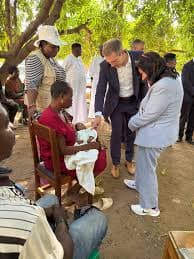
Moore’s tour included meetings with Tiv and Catholic leaders in Benue State. He also spent time in several internally displaced persons camps, where, according to Punch, he described the conditions as severe and deeply troubling.
On X, Moore wrote that he encountered dozens of Christian families who had fled violent attacks. Many, he said, shared accounts of killings and mutilations that had uprooted entire communities.
Moore relayed several testimonies, including the story of a woman who said she was forced to watch her husband and five children killed before she narrowly escaped with her unborn child. Another woman described the murder of her relatives and the violent removal of her baby. A male survivor told the delegation that his family was hacked to death and that he sustained permanent injuries while trying to flee.
The congressman estimated that more than six hundred thousand Christians currently reside in IDP camps across Benue, a state long marred by clashes between farming communities and armed groups. He argued that affected residents deserve to return to their ancestral lands without fear, and he accused armed Fulani militias of driving what he called a genocidal campaign.
While in Benue, Moore met with several figures including Bishop Wilfred Anagbe, Bishop Isaac Dugu, and James Ioruza, the traditional ruler of the Tiv people. He said the discussions were emotionally charged but constructive, adding that local leaders emphasized the scale of the violence and the need for consistent international attention.
Related News
- A Nigerian skate brand just became adidas' first official Nigerian collaborator.
- A senior ISWAP finance operative surrendered to Nigerian troops at 6:45 a.m. on July 25 along the Gamboru-Wulgo Main Supply Route in Borno State.
- Nigeria's reported digital payment fraud losses fell 52 percent last year, dropping to N25.85 billion from N52.26 billion in 2024.
Moore also held talks in Abuja with Ribadu and other senior officials. The discussions centered on terrorism in the North East and persistent killings in the Middle Belt. According to Moore, both he and President Trump consider these issues strategic priorities.

He commended Nigerian authorities for the recent rescue of more than one hundred abducted Catholic schoolchildren and pointed to what he described as a newly established joint US–Nigeria task force as a positive sign. However, he stressed that meaningful progress will depend on sustained action.
The visit occurred amid heightened diplomatic strain following the Trump administration’s decision to redesignate Nigeria as a Country of Particular Concern over alleged religious freedom violations. The move came with warnings of possible US military intervention, which Nigerian officials have rejected. Abuja maintains that insecurity affects all communities regardless of faith and denies claims of systemic persecution of Christians.
The latest engagement followed Ribadu’s November 20 stop at the Pentagon, where he met US Secretary of War Pete Hegseth to discuss coordinated strategies for tackling Nigeria’s security crisis. On the same day, the US House Subcommittee on Africa held a public hearing examining the implications of Nigeria’s new designation and the future of bilateral cooperation.
As Washington weighs policy recommendations and Nigerian authorities face growing domestic pressure to restore security, both sides have a shared interest in reducing violence and stabilizing the Middle Belt. Whether the renewed diplomatic activity will translate into lasting improvements for displaced communities remains an open question.
Add a Comment