


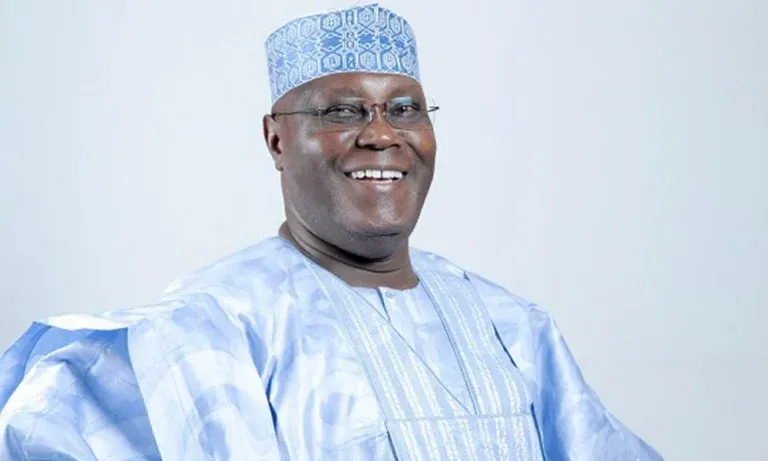
Former Vice President Atiku Abubakar secured the African Democratic Congress presidential ticket on Wednesday with 1,846,370 votes, according to figures announced at the Transcorp Hilton Congress Hall in Abuja. The result placed former Rivers State governor Rotimi Amaechi at 504,117 votes and businessman Mohammed Hayatu-Deen at 177,120.
The numbers mattered immediately.
The ADC contest was not simply a party primary. It became the clearest indication yet that opposition blocs frustrated by the dominance of the ruling establishment are attempting to consolidate earlier than they did before the 2023 election cycle. Senator David Mark, who presided over the announcement, formally presented the party flag after the declaration.
Atiku’s acceptance speech focused less on celebration than containment. He appealed directly to rivals to “close ranks” and warned party members against internal fragmentation ahead of 2027. The caution reflected recent Nigerian political history. Major coalitions have repeatedly collapsed not at the ballot box, but during negotiations over control, regional balancing and campaign financing.
That pattern remains unresolved.
The scale of the vote itself also raises questions. The announced total of 2,546,457 votes is unusually large for a party primary conducted inside a single convention venue. The ADC has not yet publicly released the delegate register, accreditation methodology or state-by-state breakdown attached to the tally. Without those documents, the figures remain politically useful but independently unverifiable.
Electoral lawyers contacted Wednesday evening pointed to previous litigation involving delegate legitimacy in both the Peoples Democratic Party and the All Progressives Congress. Abuja-based constitutional lawyer Festus Ogwuche said disputes over accreditation procedures have become “the first battlefield” in major primaries because courts increasingly examine whether delegate lists were altered after congresses.
But the political story unfolding in Abuja intersected with another disclosure thousands of kilometres away in Washington. A report detailing a Trump-era directive linked to anti-ISIS operations in Nigeria renewed attention on how dependent Abuja’s counterterrorism infrastructure became on foreign intelligence and operational support during the peak of Islamic State expansion across West Africa.
Related News
The disclosure concerned internal United States policy directives authorising expanded anti-ISIS targeting operations after Islamic State affiliates intensified activities around the Lake Chad Basin. Security analysts familiar with multinational operations in the region said the directive accelerated intelligence coordination involving Nigeria, Niger, Chad and Cameroon.
Nigeria’s security establishment has spent years publicly framing counterinsurgency gains as evidence of improved domestic military capability. Yet multiple defence assessments from the United States Department of Defense and independent conflict trackers have repeatedly documented extensive foreign logistical, surveillance and training involvement in operations targeting Islamic State West Africa Province (ISWAP).
Our analysis of publicly available conflict data from the Armed Conflict Location and Event Data Project identified more than 1,400 reported violent incidents linked to Boko Haram and ISWAP factions in Nigeria between January 2024 and May 2026. Borno State accounted for the highest concentration.
On the same day politicians negotiated coalition mathematics in Abuja, fresh public anxiety emerged over school abductions in Oyo and Borno states. The incidents revived memories of the mass kidnapping economy that expanded after the 2014 abduction of schoolgirls in Chibok. Security experts say the persistence of pupil abductions demonstrates that tactical military successes have not translated into durable territorial control in vulnerable rural corridors.
In Abia State, Governor Alex Otti announced that the Umuahia Central Bus Terminal would be named after Professor Nnenna Oti. The decision followed her national prominence during the 2023 elections, when she served as returning officer in Abia and resisted pressure surrounding result collation.
Public infrastructure projects in Nigeria are frequently named after former governors, military rulers or party financiers. Naming a transport terminal after an academic associated with electoral credibility signals an attempt to associate the current administration with institutional integrity. Yet opposition figures in Abia immediately questioned the timing, noting that several road rehabilitation projects announced in 2024 remain incomplete, according to state budget implementation records reviewed by civic monitoring groups.
Outside Nigeria, members of the Nigerian diaspora in the United Kingdom continued fundraising efforts for the family of Kayode Ogunbodede, a father of two reported to have died in his sleep. Community organisers coordinating support campaigns said rising funeral repatriation costs and immigration-related financial strain have left many migrant families exposed after sudden deaths.
Data published by the UK Office for National Statistics showed the cost of funerals in Britain continued rising through 2025, while currency instability in Nigeria has increased the expense of repatriation and local burial arrangements for diaspora families. Organisers involved in Ogunbodede’s fundraiser estimated that transportation, documentation and burial-related expenses could exceed £15,000.
Back in Abuja, the immediate political calculation surrounding Atiku’s victory is straightforward. Opposition strategists believe economic frustration, inflation and insecurity have created conditions for coalition politics to regain traction before 2027. Yet coalition building in Nigeria has historically depended less on ideology than on elite negotiation over access to state structures.
We reviewed past presidential alliance negotiations involving the 2013 merger that created the APC and found that ministerial allocation, zoning commitments and campaign financing arrangements dominated internal discussions more than policy alignment. Several politicians now entering ADC negotiations participated in those earlier deals.
Atiku Abubakar won the ADC ticket with a margin large enough to immediately reposition the party ahead of 2027, but the delegate figures still lack public verification documents.
Security disclosures tied to Trump-era anti-ISIS directives renewed scrutiny over how heavily Nigeria’s counterterrorism operations relied on foreign intelligence coordination.
The abduction concerns in Oyo and Borno states showed that school security remains fragile despite repeated federal claims of improved territorial control.
Governor Alex Otti used the naming of a major transport terminal after Professor Nnenna Oti to reinforce a political message about institutional credibility.
Why are analysts questioning the ADC vote figures?
Because the party announced more than 2.5 million votes without publicly releasing delegate accreditation records or a state-by-state breakdown. In Nigerian politics, those documents often become evidence in court challenges.
Does the US anti-ISIS disclosure mean Nigeria could not fight ISWAP alone?
Not exactly. Nigerian forces carried out operations directly. But intelligence sharing, surveillance assets and multinational coordination played a larger role than officials sometimes publicly acknowledge.
Why does naming a bus terminal after Nnenna Oti matter politically?
Because she became nationally recognised during the 2023 election controversy in Abia. Associating her name with public infrastructure allows the state government to signal alignment with electoral credibility and reform messaging.
The unresolved question now sits with both politicians and lawyers in Abuja. If rival aspirants challenge delegate accreditation or vote computation procedures, the dispute is likely to move before the Federal High Court well before formal campaign season begins. The ADC has not released the certified delegate register, and no timeline has been announced for publication. Control over a presidential ticket, future campaign financing and access to coalition negotiations now depend on documents the public still has not seen.
Add a Comment