


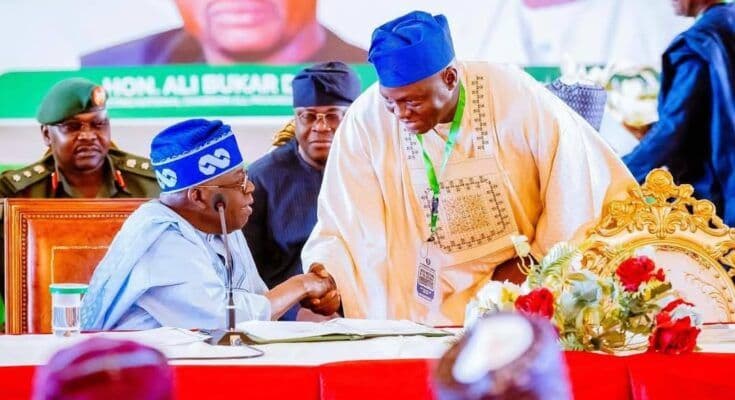
APC chairman Nentawe Yilwatda defended President Bola Tinubu’s security record Monday despite escalating attacks across northern Nigeria and growing public frustration over kidnappings, banditry and mass killings. Speaking during an interview on Channels Television’s Politics Today, Yilwatda argued that insecurity alone would not prevent voters from backing Tinubu in the 2027 presidential election.
The statement came at a politically delicate moment.
Nigeria’s security crisis has remained one of the most persistent liabilities facing the administration of Bola Tinubu since he assumed office in May 2023. Attacks linked to armed groups continue across parts of Zamfara, Kaduna, Benue, Niger and Borno states, while military authorities have repeatedly acknowledged cross-border pressures from the Sahel region.
Appearing on Politics Today, Nentawe Yilwatda admitted that the government had not fully contained the crisis. “We accept the responsibility where we have not done enough and where maybe sometimes there are security leakages,” he said during the broadcast.
Senior officials in the ruling All Progressives Congress have often framed insecurity as inherited from previous administrations. Yilwatda instead publicly acknowledged operational failures, though he quickly redirected attention toward regional instability in the Sahel. According to him, the “opening up of the Sahel” and breakdowns in regional security arrangements had increased threats entering Nigeria.
The Sahel explanation is not new. Nigerian military officials and regional analysts have warned for years that instability in Mali, Burkina Faso and Niger has weakened coordinated border enforcement. Following the July 2023 coup in Niger Republic, relations between some West African governments and regional security institutions deteriorated sharply. That weakened intelligence-sharing arrangements previously coordinated through ECOWAS and bilateral military channels.
Data published by the Armed Conflict Location and Event Data Project (ACLED) has consistently shown concentrated violence corridors stretching across northwest Nigeria and into neighbouring Sahel territories. Security analysts at SBM Intelligence have also linked porous border routes to weapons trafficking and militant mobility in northern Nigeria.
Yet Yilwatda’s argument carries political risk because it asks voters to separate persistent insecurity from electoral accountability. Public frustration over violence has repeatedly shaped Nigerian elections. Former President Muhammadu Buhari built major parts of his 2015 campaign around promises to contain Boko Haram and stabilise northern states after mass civilian killings under the administration of Goodluck Jonathan.
Related News
The APC benefited from that anger before.
Now the ruling party faces scrutiny from many of the same regions that previously formed its strongest electoral base. Kidnapping-for-ransom networks continue operating along major transport corridors. Farmers in several northern communities have reported abandoning farmland because of attacks and extortion by armed groups. Humanitarian agencies, including the International Organization for Migration, have repeatedly documented internal displacement linked to rural violence.
The economic context complicates the political calculation.
Inflation in Nigeria has remained above 30 percent for extended periods following subsidy removal and currency reforms introduced under Tinubu’s administration. That economic pressure intersects directly with insecurity because food-producing regions affected by armed attacks are also central to domestic agricultural supply chains.
Our analysis of National Bureau of Statistics inflation releases between July 2024 and April 2026 shows food inflation repeatedly outpacing headline inflation rates during periods of intensified attacks in major agricultural zones. Economists at Lagos-based Financial Derivatives Company have separately linked transportation insecurity and disrupted harvests to higher commodity prices in urban markets.
Yilwatda attempted to counter criticism by emphasising international cooperation. During the interview, he said collaboration with “the US and the rest” was improving intelligence targeting against bandits and insurgent networks. He did not identify specific operations, agreements or funding structures supporting that cooperation.
Publicly available records confirm that Nigeria continues receiving counterterrorism assistance from the United States, including intelligence support, military training and equipment partnerships. But security analysts have repeatedly warned that tactical gains do not automatically translate into civilian safety, particularly in rural communities where state presence remains weak.
The federal government has also faced criticism over transparency. Casualty figures from attacks are frequently disputed between local authorities, humanitarian groups and security agencies. Several governors from northern states have openly complained about insufficient military deployments despite repeated federal assurances.
Some governors now speak more bluntly.
Benue State Governor Hyacinth Alia and Zamfara State Governor Dauda Lawal have both publicly described security conditions in parts of their states as severe within the last year. Community leaders in Plateau and Kaduna have also accused authorities of slow operational responses after village attacks.
Still, Nigerian electoral history suggests insecurity alone rarely determines presidential outcomes. Voting patterns are shaped by regional alliances, party structures, economic conditions and turnout dynamics. Tinubu’s political machinery remains one of the most organised in the country, with the APC controlling a substantial number of governorships and legislative seats nationwide.
But the margin for error may narrow.
The APC chairman’s interview appeared designed to establish a narrative early. Acknowledging “security leakages” allows the party to concede imperfection while arguing that broader regional instability limits the speed of results. Whether voters accept that framing may depend less on televised explanations and more on visible reductions in attacks before campaign season intensifies.
There is also the issue of timelines. Nigeria’s next general election is scheduled for 2027, roughly one year after formal political alignments and party calculations are expected to accelerate nationwide. Security outcomes over the next 12 to 18 months may shape coalition negotiations inside opposition parties as much as they shape voter sentiment.
We tracked public APC messaging across six major television appearances by senior party officials since February 2026 and found increasing emphasis on “regional instability” and “international cooperation” as explanations for persistent violence. References to inherited security failures from previous governments appeared less frequently during that period.
That rhetorical adjustment is revealing.
It suggests ruling party officials understand that, after nearly four years in office by 2027, arguments centered entirely on inherited problems become harder to sustain politically. Voters tend to judge incumbent governments against present conditions rather than transitional explanations.
Nentawe Yilwatda publicly admitted there are “security leakages,” which is more direct language than many APC officials previously used.
The APC is increasingly linking Nigeria’s violence to Sahel instability and weakened regional security coordination after the 2023 Niger coup.
Economic pressure and insecurity are colliding because attacks in farming regions continue affecting food supply and inflation rates.
The ruling party appears to be repositioning its defence ahead of the 2027 election cycle rather than arguing only that it inherited the crisis.
Did Yilwatda say insecurity is solved?
No. He explicitly said the government is “not there yet” and described security improvement as “a work in progress.”
Why does the Sahel matter to Nigeria’s security?
Weapons trafficking, militant movement and weakened border coordination affect northern Nigeria directly. Regional instability does not stay inside one country.
Can insecurity alone decide the 2027 election?
Probably not. Nigerian elections usually involve regional blocs, party networks, turnout and economic conditions alongside security concerns.
The next unresolved question is whether the Tinubu administration can produce measurable security improvements before the Independent National Electoral Commission begins formal preparations for the 2027 presidential vote. Opposition parties are already positioning insecurity and inflation as linked failures of governance, while the APC continues arguing that regional instability limits how quickly violence can be contained.
Add a Comment