


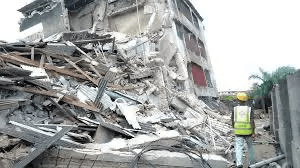
Residents of Odo-Kekere Community in the Ikorodu area of Lagos State were gripped by fear on Thursday evening after part of a structure within a public school suddenly collapsed, an incident that reignited concerns about the condition of ageing educational infrastructure across the state.
The incident occurred after school hours, a factor many residents described as a narrow escape. According to eyewitness accounts, a section of the school building gave way late in the evening, producing a loud, thunder-like sound that sent nearby residents rushing out of their homes to see what had happened.
Preliminary information indicates that no students were present in the affected classrooms at the time of the collapse. Emergency responders, however, were immediately mobilised amid fears that security personnel or school staff might still have been within the premises.
Emergency agencies move in
First responders from the Lagos State Emergency Management Agency and the Lagos State Building Control Agency arrived at the scene shortly after the incident was reported. According to officials at the site, the area was cordoned off to prevent residents from getting too close to the unstable structure.
Emergency teams commenced search and rescue operations to ensure that no individuals were trapped under the rubble. As of press time, there had been no confirmation of casualties.
Officials said investigations were ongoing to determine the remote and immediate causes of the collapse, as well as the extent of structural damage to the affected building and adjoining facilities within the school compound.
According to reports from the scene, engineers from LASBCA were carrying out an initial integrity assessment to determine whether other parts of the school pose similar risks.
Related News
Eyewitness accounts and community reaction
Residents living close to the school described moments of confusion and fear as the structure came down without warning. Mrs Boluwaji Aderinto, whose residence shares a boundary with the school, said the sound of the collapse was alarming.
“We heard a loud crack and then dust everywhere,” Aderinto said. “People started shouting because nobody knew if children or adults were inside. We thank God it did not happen in the morning when pupils would have been sitting in their classrooms.”
She added that parents and community leaders had, on several occasions, raised concerns about the deteriorating condition of some school buildings in the area.
“This is not the first time we have complained. This school has old structures that clearly need renovation. This incident should be a wake-up call for the government before something worse happens,” she said.
Other residents echoed similar sentiments, noting that while the absence of pupils at the time of the collapse prevented a tragedy, the incident had heightened anxiety among parents whose children attend public schools in the Ikorodu axis.
Background concerns over ageing school infrastructure
The partial collapse has drawn attention once again to the broader issue of ageing public infrastructure in Lagos schools, particularly in densely populated suburban communities.
Over the years, education stakeholders have warned that many public school buildings constructed decades ago have not undergone comprehensive structural upgrades, despite increased enrolment and daily usage. According to education sector observers, prolonged exposure to weather conditions, coupled with limited maintenance budgets, has left several school structures vulnerable.
Although Lagos State has embarked on various school rehabilitation and reconstruction programmes in recent years, community leaders argue that interventions have not always kept pace with the scale of infrastructural decay, especially in rapidly expanding areas like Ikorodu.
According to reports, parents in Odo-Kekere had previously appealed to authorities to inspect and renovate older classroom blocks within the school, citing visible cracks and weakened walls.
Government response and on-the-spot assessment
Meanwhile, a high-level delegation from the Lagos State Ministry of Education visited the scene on Thursday evening for an on-the-spot assessment.
Officials from the ministry were seen inspecting the affected structure alongside personnel from emergency agencies. According to sources familiar with the visit, the delegation was briefed on the immediate response efforts and the preliminary findings from building control officers.
While no official statement had been issued by the ministry as of press time, officials indicated that a full report would be compiled to guide next steps, including possible demolition of unsafe sections and temporary relocation of classes if necessary.
State authorities have, in past incidents, pledged zero tolerance for compromised building safety, particularly in schools. However, residents say enforcement and proactive inspections remain uneven.
Why the incident matters now
The collapse comes amid heightened public sensitivity around building safety in Lagos, following previous incidents involving residential and commercial structures. Education advocates say the latest incident underscores the need for routine structural audits of school buildings, not only after visible damage occurs.
According to an education policy analyst based in Lagos, who spoke on condition of anonymity, schools should be treated as critical infrastructure.
“Children spend a significant part of their day in these buildings. Waiting for partial collapses before taking action is a risky approach. Preventive inspections and timely rehabilitation are far more cost-effective and safer,” the analyst said.
The incident also raises questions about emergency preparedness within school environments, including the presence of trained safety officers and clear evacuation protocols.
In the coming days, attention will focus on the outcome of structural assessments by LASBCA and the Ministry of Education. Parents and residents are expected to press for clear timelines on repairs, as well as assurances that other buildings within the school compound are safe for use.
There may also be renewed calls for a comprehensive audit of public school infrastructure across Ikorodu and other fast-growing parts of Lagos State, to identify at-risk structures before another near-miss occurs.
For now, residents of Odo-Kekere are relieved that the collapse happened after school hours. However, the incident has left behind a lingering sense of unease and a renewed demand for decisive action to protect pupils, teachers and school staff.
The partial collapse of a public school building in Odo-Kekere serves as a stark reminder of the risks posed by ageing infrastructure when maintenance lags behind need. While the absence of casualties offers some relief, the incident has amplified longstanding concerns from parents and community leaders.
As investigations continue, many will be watching to see whether this near-tragedy leads to sustained reforms in school safety oversight, or fades into a familiar cycle of concern followed by inaction.
Add a Comment