


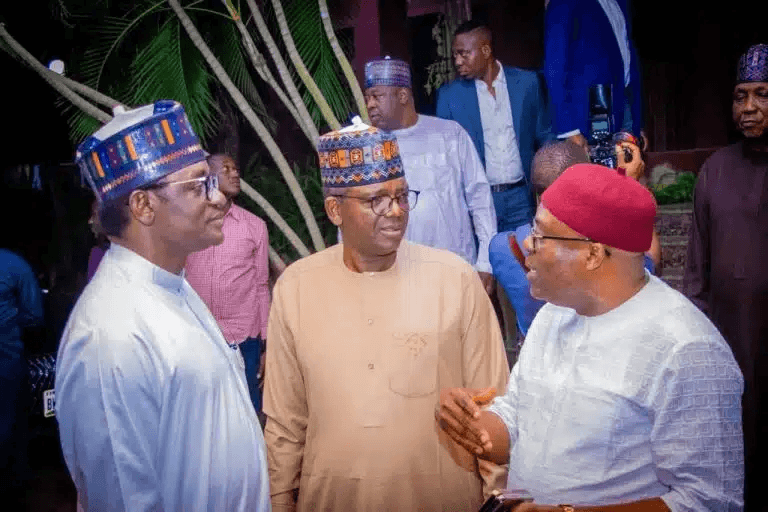
The All Progressives Congress has taken an early step toward internal reconciliation and political consolidation with the inaugural meeting of its Strategy, Conflict Resolution and Mobilisation Committee. The closed-door session was held on Monday in Abuja, just weeks after President Bola Tinubu formally inaugurated the committee to address lingering divisions within the ruling party.
Naija News reports that the meeting took place at the Yobe State Governor’s Lodge in the Federal Capital Territory. It was hosted by the committee’s chairman and Governor of Yobe State, Mai Mala Buni, whose role places him at the centre of the APC’s renewed effort to stabilise its internal structures ahead of future political contests.
High-level attendance underscores importance
The meeting attracted several serving governors and senior party figures, highlighting the strategic weight the APC leadership has attached to the committee’s mandate. Among those present were Governors Hope Uzodimma of Imo State, Siminalayi Fubara of Rivers State, Hyacinth Alia of Benue State, Sheriff Oborevwori of Delta State, Uba Sani of Kaduna State, and Biodun Oyebanji of Ekiti State.
Also in attendance were the Minister of State for Defence, Bello Matawalle, and the Minister of Marine and Blue Economy, Adegboyega Oyetola. Former Kogi State Governor Yahaya Bello was present, alongside other influential party figures including Senator Kabiru Marafa, former APC National Legal Adviser Muiz Banire, and Ibrahim Masari, Special Assistant to President Bola Tinubu on Political Affairs.
Party insiders say the mix of current office holders and experienced party operatives reflects an attempt to combine political authority with institutional memory as the APC seeks to manage internal disputes more effectively.
Notable absences raise quiet questions
Despite the strong turnout, three governors who are members of the committee were absent from the inaugural meeting. They are Bassey Otu of Cross River State, AbdulRahman AbdulRazaq of Kwara State, and Umar Namadi of Jigawa State.
Related News
No official explanation was given for their absence. However, party sources caution against reading too much into it, noting that scheduling conflicts are common at this level. Even so, political observers say attendance patterns at early meetings often attract attention, particularly when the committee’s purpose is cen 00tred on unity and reconciliation.
Background to the committee’s creation
Naija News recalls that President Bola Tinubu inaugurated the Strategy, Conflict Resolution and Mobilisation Committee on December 24. At the event, he charged members with the task of resolving internal disagreements that have persisted across several state chapters of the APC.
Since emerging as Nigeria’s dominant political party, the APC has grappled with factional disputes, contested congresses, and disagreements over candidate selection. While the party has often managed to paper over cracks during election cycles, analysts say unresolved internal conflicts have weakened cohesion in some states.
According to party officials familiar with the process, the new committee was designed to provide a standing mechanism for mediation, rather than relying on ad hoc interventions from national leaders.
Focus of the inaugural meeting
Although the meeting was held behind closed doors, sources within the party say discussions centred on establishing a clear working framework for the committee. This reportedly included agreeing on procedures for handling disputes, identifying priority states where reconciliation efforts are most urgent, and coordinating mobilisation strategies ahead of future political engagements.
According to reports, members also discussed how to engage aggrieved party stakeholders without escalating tensions, especially in states where internal divisions have spilled into public disagreements or court cases.
One party official described the meeting as foundational, noting that the emphasis was on structure and process rather than immediate resolutions.
The committee’s activation comes at a sensitive time for the APC. While the party controls the federal government and a majority of state governments, it faces growing pressure to maintain unity amid economic reforms and evolving political alliances.
Analysts note that internal cohesion will be critical as the party prepares for off-cycle elections, local government contests, and longer-term planning toward future general elections. Disunity at the state level could weaken mobilisation efforts and open space for opposition parties to make inroads.
According to a political analyst based in Abuja, the creation of a standing conflict resolution body signals recognition within the APC that internal disputes, if left unmanaged, can erode electoral advantages even for dominant parties.
Mobilisation beyond elections
Beyond conflict resolution, the committee’s mandate includes strengthening mobilisation across the country. This suggests a broader role that goes beyond settling disputes to rebuilding grassroots structures and maintaining party visibility between election cycles.
Party sources say this aspect of the committee’s work is aimed at preventing the pattern where party structures become dormant outside campaign periods, leaving room for factional leaders to fill the vacuum.
Mobilisation is also expected to involve outreach to youth and women groups within the party, as well as re-engagement with members who may have become disillusioned during previous internal crises.
Early reactions within the party
While no formal communiqué was issued after the meeting, reactions within APC circles have been cautiously positive. Some party members see the committee as an opportunity to institutionalise dialogue and reduce the influence of informal power brokers in resolving disputes.
Others, however, stress that the effectiveness of the committee will depend on its willingness to take difficult decisions and its ability to command respect across rival factions.
According to one senior party member, reconciliation efforts often fail when recommendations are not followed through or when enforcement is selective.
Attention will now turn to the committee’s next steps, including whether it begins engagements with state chapters facing unresolved disputes. Observers will also be watching for signals on how quickly the committee moves from planning to action.
Another key issue will be whether the APC leadership publicly endorses and enforces the committee’s recommendations, especially in politically sensitive states.
If successful, the committee could become a model for managing internal party democracy within Nigeria’s highly competitive political environment.
The inaugural meeting of the APC Strategy, Conflict Resolution and Mobilisation Committee marks a deliberate effort by the ruling party to confront its internal challenges in a more structured way. With high-profile attendance and a clear mandate from President Bola Tinubu, the committee begins its work under close political scrutiny.
Whether it succeeds will depend not only on strategy, but on sustained commitment from party leaders to prioritise unity over factional interests.
Add a Comment