


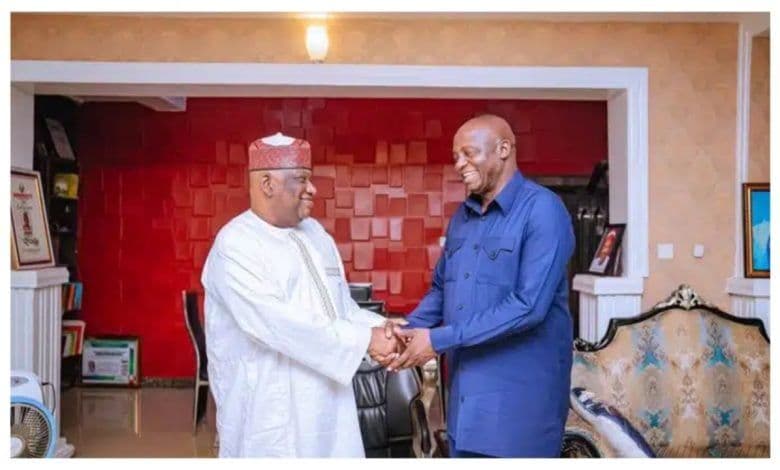
Nentawe Yilwatda met Rufai Hanga on Thursday. Nothing more was confirmed.
The meeting between the All Progressives Congress national chairman and the senator representing Kano Central matters because it is the second contact in weeks between APC officials and a man widely seen as one of Rabiu Kwankwaso's closest political allies. If Hanga leaves the Nigeria Democratic Congress before 2027, it would mark one of the most significant defections in Kano's political realignment ahead of the next general election.
Yilwatda called it a courtesy visit. He told reporters afterward that discussions centered on "peace, unity, stability and development" in Kano State. He added that political actors must keep talking to one another "regardless of party differences." His fuller quote: "Nigeria's progress is best served when we build bridges of understanding, encourage constructive dialogue, and place the welfare of citizens above partisan considerations."
That framing did little to quiet speculation. Hanga has not spoken publicly. Neither have members of his political team. Their silence, extending across multiple reported approaches from the APC, has become as significant to Kano political observers as anything said on the record.
A second visit, not the first
Thursday's meeting was not the opening move. It followed an earlier visit by a delegation of APC leaders in Kano, led by state Vice Chairman Salisu Maje Gwangwazo. That delegation appealed directly to Hanga to join the ruling party, according to accounts of the meeting. Party leaders reportedly told him his political experience would be valued within the APC. They also argued, according to the same accounts, that he had gone under-recognized despite years of loyalty to Kwankwaso's political structure.
That argument lands differently now than it might have a year ago. Hanga was unable to secure his party's ticket for another Senate run in Kano Central, according to sources familiar with the situation. He was also said to have been under consideration for a major position within the party's internal calculations ahead of future elections. That did not materialize either.
Two failures. One after the other. Sources close to the matter say APC leaders intensified their outreach specifically after those setbacks became apparent.
Related News
The removed photographs
The detail drawing the most attention in Kano political circles is smaller than either meeting. Photographs linked to the Kwankwasiyya movement, along with NDC insignia, were reportedly removed from Hanga's office. No one has said who removed them, or exactly when. No one from Hanga's office has explained why.
In Nigerian political culture, where party symbols in an officeholder's workspace function as a visible loyalty marker, their absence is rarely accidental. It is also rarely explained in advance of a formal announcement. That pattern, more than any quote from either party, is what has convinced local observers that a defection is being prepared rather than merely rumored.
Hanga's position inside the NDC was never simple. He is regarded as one of the most trusted lieutenants of Kwankwaso, the former Kano State governor who built the Kwankwasiyya movement into a political force capable of shifting the state's outcomes in national elections. Kwankwaso's endorsement carries weight across Kano Central, the same district Hanga represents in the Senate.
That relationship is precisely what makes his potential move to the APC significant beyond one Senate seat. A defection by Hanga would not just remove a sitting senator from the NDC column. It would test whether Kwankwaso's structure can hold its senior figures through a contested election cycle, or whether the APC's outreach strategy in Kano, run through Gwangwazo's delegation and now through the national chairman directly, is beginning to work.
What the APC is not saying
Yilwatda's public language never mentioned recruitment. He spoke of cooperation, dialogue, and citizen welfare. Standard language for a chairman managing a sensitive political conversation without confirming it.
But the timing undercuts the framing. A courtesy visit rarely follows a party delegation's direct appeal for defection by only weeks. Nor does a courtesy visit typically coincide with reports of party symbols disappearing from an officeholder's office.
Political watchers in Kano note that neither the APC nor Hanga's camp has denied the substance of the reports, only declined to confirm them. That distinction, between denial and silence, is one Nigerian political operatives have used for decades to manage defections before they are formally announced. It allows all sides room to reverse course, or to time an announcement for maximum effect, without anyone having lied outright in the interim.
What remains unconfirmed
Hanga has not issued a statement. His office has not responded to questions about the removed photographs or insignia. The NDC has not commented on whether it considers the senator's position within the party secure.
The APC, for its part, has not said whether Thursday's meeting produced any commitment, timeline, or condition for Hanga's membership. Yilwatda's remarks addressed only the stated purpose of the visit, not what, if anything, was agreed behind closed doors.
Whether Hanga announces a move before the 2027 election cycle formally opens, and whether Kwankwaso responds publicly if he does, are the two questions that will determine how this story develops next. Neither camp has set a timeline for either.
Add a Comment