


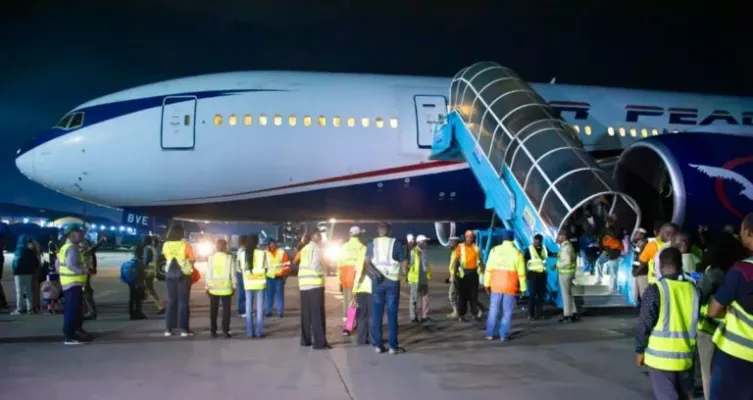
A Boeing 777-200 landed in Lagos on Wednesday. It carried the last 308 Nigerians out of South Africa.
The flight closed a federal government evacuation operation that began amid a security crisis affecting Nigerian citizens in South Africa, and it matters now because it tests whether Nigeria's response to citizens in danger abroad extends beyond a single high-profile airlift to a sustained, repeatable operation. Five missions in, the government says it has an answer.
Air Peace spokesperson Efe Osifo-Whiskey confirmed the numbers in a statement issued Wednesday in Lagos. The final flight brought the cumulative total to 1,393 Nigerians transported across five humanitarian evacuation missions, according to the airline. The aircraft touched down at Murtala Muhammed International Airport and taxied to the Cargo and Hajj Terminal, the same terminal used for the airline's earlier evacuation arrivals.
That detail, the terminal assignment, is not incidental. Routing evacuation flights through the Cargo and Hajj Terminal rather than the main international arrivals hall has been the airline's pattern across this operation, keeping returning citizens separate from regular passenger traffic as immigration and diaspora officials process them on arrival.
Who met the flight
Abike Dabiri-Erewa, chief executive of the Nigerians in Diaspora Commission, received the returnees alongside senior immigration officials, according to the statement. Dabiri-Erewa sympathized with the returnees over what the statement described as hardships experienced during the crisis. She also conveyed a reassurance from President Bola Tinubu that government support would continue.
Dabiri-Erewa affirmed the administration's commitment to the returnees' reintegration and welfare following arrival, the statement said. No further detail was provided on what reintegration support entails, what agencies are responsible for delivering it, or over what timeframe.
That absence matters. An evacuation flight is a single, verifiable event: an aircraft lands, a manifest is counted, officials appear for photographs. Reintegration is not. It requires housing, employment support, and in many cases medical or psychological care for people who left South Africa under threat. The statement names the commitment. It does not name the mechanism.
Related News
- The Senate has approved a N50 million payout to the families of five people killed during the rescue of children kidnapped from Oriire, Oyo State.
- Lagos Vows to Keep Bulldozers Rolling on Badagry Corridor Shanties
- The West African College of Physicians called on Nigeria's federal and state governments Saturday to overhaul how the country pays for healthcare.
The numbers behind the operation
Air Peace said it deployed its Boeing 777-200 wide-body aircraft across five dedicated evacuation missions to complete the airlift of 1,393 Nigerians. The airline did not break down passenger counts for each of the first four flights in Wednesday's statement, leaving the 308 figure for the final flight as the only individual mission total confirmed on the record.
The airline framed the operation in its own language as proof of "successful humanitarian response" and of what it called strong public-private collaboration. Osifo-Whiskey's statement quoted the airline saying each flight "carried families back to loved ones, restored hope to those displaced by uncertainty and reaffirmed that Nigerians can rely on their nation."
That is the airline's characterization, not an independent assessment. Air Peace is not a neutral party. It is the operator that carried out the evacuation and stands to benefit reputationally, and commercially, from being seen as the government's humanitarian air carrier of choice. The airline said the operation strengthened its position as what it called Nigeria's leading humanitarian airline, a claim made in the same statement announcing its own completed contract.
A pattern, not a one-off
Air Peace said it has undertaken more than 20 humanitarian and evacuation missions across Africa and beyond since it began operations, covering emergency repatriations and national response efforts. The South Africa operation is the airline's latest, not its first, and the statement frames it as continuous with past work rather than as an isolated response to one crisis.
What triggered this specific evacuation is described in the statement only as "the security situation affecting Nigerians in South Africa." No date is given for when that situation began, no incident is named, and no South African government response is quoted. The statement is silent on whether the evacuation was requested by affected Nigerians, negotiated between the two governments, or initiated unilaterally by Abuja.
That silence leaves the underlying cause of the crisis undocumented in the airline's own account of its resolution. A statement announcing the end of an evacuation is not obligated to explain its beginning, but the absence is conspicuous given how much space the release devotes to praising the operation's execution.
What is not yet known
The statement does not say how many Nigerians remain in South Africa, whether any declined evacuation, or whether the security situation prompting the operation has been resolved on the ground. It does not name a government agency responsible for verifying the final headcount independent of the airline's own figures.
Dabiri-Erewa's commission has not published a separate accounting of the 1,393 total, nor detailed what reintegration support will look like for returnees now dispersed from a single Lagos arrival point back to homes across Nigeria. Whether that commitment produces documented support, or whether it ends with Wednesday's reception at the terminal, is the question the diaspora commission has not yet answered.
Add a Comment