


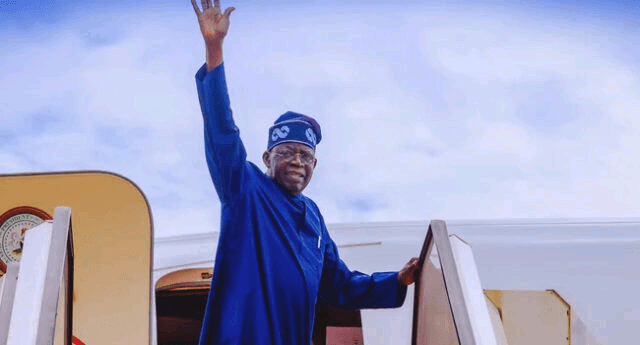
President Bola Tinubu, Vice President Kashim Shettima, and their aides are projected to spend a combined ₦12.2 billion on foreign and domestic travel in 2026, according to detailed budget estimates submitted to the National Assembly under the 2026 Appropriation Bill.
The figures are contained in the proposed State House budget, which outlines planned expenditure for the Presidency, the Vice President’s Office, and the State House Headquarters in the coming fiscal year. According to the document, international travel continues to account for the largest share of travel and transport spending, even as the federal government pursues fiscal reforms and urges tighter control of public finances.
Breakdown of presidential travel allocations
Under the proposal, President Tinubu’s travel and transport allocation totals ₦7.014 billion for 2026. Of that amount, ₦6.14 billion is set aside for international travel and associated logistics, while ₦873.89 million is earmarked for domestic travel and transport.
According to budget details, these provisions cover official trips, diplomatic engagements, and logistical support tied to the president’s movements within and outside Nigeria. International travel alone accounts for nearly 88 percent of the president’s total travel and transport vote.
In addition to travel, the president’s budget includes ₦179.01 million for the purchase of motor vehicles, reflecting ongoing fleet renewal and operational needs. Food and catering supplies are allocated ₦375.19 million, while drugs and medical supplies receive ₦79.68 million. Refreshment and meal expenses are pegged at ₦56.43 million.
Overall, total allocations linked to the president amount to ₦8.39 billion, including items beyond those explicitly listed in the budget summary. Capital expenditure within this envelope stands at ₦777.19 million, indicating spending on assets and longer term support facilities.
Vice President’s travel and office costs
The Vice President’s Office is also projected to incur significant travel expenses in 2026. A total of ₦1.732 billion is budgeted for Vice President Shettima’s travel and transport for the fiscal year.
Of this sum, ₦1.31 billion is designated for international travel, while ₦417.49 million is reserved for local movement. According to the estimates, overseas trips again represent the bulk of planned travel spending for the vice president.
Beyond travel, the Vice President’s Office has allocations for routine operational costs. Food and catering supplies are budgeted at ₦171.03 million, refreshment and meals at ₦14.99 million, and honorarium and sitting allowances at ₦21.8 million. Welfare packages receive ₦28 million, while publicity and advertisement is allocated ₦11.83 million.
Taken together with other budgeted items, the Vice President’s total allocation stands at ₦2.64 billion. Capital expenditure within this figure is estimated at ₦641.39 million, reflecting investments in assets and longer term infrastructure to support the office.
State House Headquarters spending
Separate from the allocations for the president and vice president, the State House Headquarters is proposed to receive ₦43.20 billion in 2026. This figure is broken down into ₦2.64 billion for personnel costs, ₦10.10 billion for overheads, and ₦30.49 billion for capital expenditure.
Within the State House Headquarters budget, ₦3.433 billion is specifically allocated for travel and transport classified as general, covering movements by officials and administrative logistics not directly tied to the president or vice president.
The capital budget reveals several large ticket items. The purchase of motor vehicles is allocated ₦11.23 billion, while vehicle spares and maintenance are budgeted at ₦3.84 billion. Rehabilitation and repairs of office buildings are pegged at ₦8.48 billion, and rehabilitation of residential buildings is set at ₦44.21 million.
Another notable provision is ₦7 billion for the installation and provision of solar power within the Presidential Villa, reflecting ongoing efforts to reduce reliance on the national grid and cut long term energy costs.
Wildlife conservation within the State House grounds receives ₦2.424 billion, according to the budget. In addition, ₦2.12 billion is set aside for honorarium and sitting allowances, ₦2.56 billion for office furniture and fittings, and ₦513.84 million for welfare packages.
Other allocations include ₦371.80 million for library books and equipment, ₦12.19 million for sporting and gaming equipment, and ₦11.71 million for the construction and provision of office buildings.
Why the figures matter now
The scale and composition of the proposed spending come at a time when the federal government has repeatedly stressed the need for fiscal discipline, subsidy reforms, and more efficient use of public resources. Travel costs, especially foreign travel, have become a focal point of public debate as Nigerians grapple with inflation, currency pressures, and rising living costs.
Public finance analyst Ayo Johnson said the dominance of international travel in the presidency’s budget reflects Nigeria’s active diplomatic posture but also raises questions about prioritisation.
“Foreign engagements are important for investment, security cooperation, and diplomacy,” Johnson explained. “However, in a period of fiscal tightening, lawmakers and the public will want clearer justification for the scale of these allocations and the outcomes they are expected to deliver.”
The 2026 Appropriation Bill is currently before the National Assembly, where committees are expected to scrutinise the estimates in detail. Lawmakers may seek explanations from State House officials on the necessity and breakdown of major cost items, particularly travel, vehicle procurement, and capital projects.
Budget watchers say amendments remain possible as the review process unfolds, especially if legislators push for reductions or reallocation in response to public concerns.
For now, the proposed figures offer an early snapshot of the administration’s spending priorities for 2026. How much of the ₦12.2 billion projected for presidential and vice presidential travel survives the legislative process will be closely watched, both as a signal of fiscal restraint and as an indicator of how the government balances international engagement with domestic economic realities.
Suggested visual elements
Editors may consider a comparative chart showing travel allocations for the president, vice president, and State House Headquarters side by side. A simple pie chart breaking down foreign versus local travel could also help readers quickly grasp where most of the money is directed.
The 2026 State House budget proposals underline the continued prominence of travel, infrastructure, and operational spending within the Presidency. As the National Assembly begins its review, the debate is likely to centre not just on the size of the allocations, but on their alignment with broader economic reforms and public expectations of prudent governance.
Add a Comment