


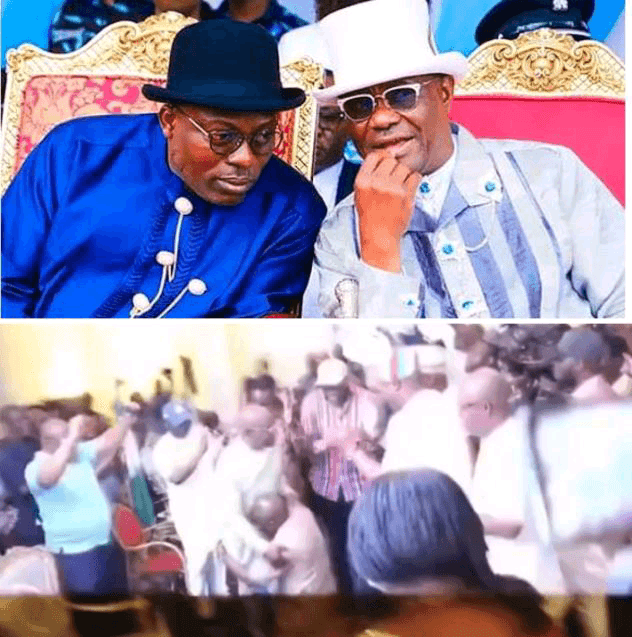
A throwback video showing Rivers State Governor Siminalayi Fubara kneeling before former governor and current Minister of the Federal Capital Territory, Nyesom Wike, has resurfaced online, adding fresh heat to the long-running political feud between both men.
The video was shared on social media by Lere Olayinka, a media aide to Wike, at a time when tensions between the two camps have again escalated. According to reports, the clip dates back to shortly after the Independent National Electoral Commission declared Fubara the winner of the March 2023 governorship election in Rivers State.
In the footage, Fubara, who was widely regarded as Wike’s anointed successor, is seen kneeling to express gratitude to Wike following his electoral victory. The moment, which had previously circulated quietly among political circles, has now re-emerged in a much more charged context.
Timing of the video raises political stakes
Observers note that the timing of the post is as significant as the content itself. The video surfaced amid renewed hostilities between Wike and his former protégé, following months of strained relations that have reshaped Rivers State’s political landscape.
Although the video does not contain new material, analysts say its reappearance is intended to reinforce a narrative of political indebtedness. By sharing the clip now, Wike’s camp appears to be reminding the public of Fubara’s origins and the role Wike played in his rise to power.
According to political analyst Deji Adeniyi, the move is less about the past and more about influence in the present. He said such symbolic reminders are often deployed when political loyalty is perceived to be slipping.
“In Nigerian politics, visual symbolism carries weight,” Adeniyi explained. “A clip like this is meant to frame the power dynamic and question whether the governor has fully broken away from his political godfather.”
Background to the Wike–Fubara fallout
Fubara emerged as Rivers State governor in 2023 under the platform of the Peoples Democratic Party, succeeding Wike after eight years in office. During the campaign, Wike openly backed Fubara, describing him as the most qualified candidate to continue his political legacy in the state.
However, relations between both men began to deteriorate months after Fubara assumed office. The rift became public as disagreements surfaced over control of the state legislature, party structure, and key appointments.
At the height of the crisis, the Rivers State House of Assembly was split between lawmakers loyal to Wike and those aligned with the governor. The standoff drew national attention, prompting interventions from party leaders and other political stakeholders.
Despite periods of relative calm, the dispute has never been fully resolved. The resurfaced video suggests that both camps are still actively engaged in a battle for public perception and political relevance.
Why the development matters now
The renewed circulation of the video comes at a sensitive moment for Rivers State, where governance has often taken a back seat to political maneuvering. Analysts warn that prolonged elite conflicts risk distracting from pressing issues such as infrastructure, security, and economic development.
Meanwhile, the feud also has implications beyond Rivers State. Wike remains a powerful political figure at the national level, serving as FCT minister under President Bola Tinubu, despite being a prominent PDP chieftain. His continued influence in Rivers politics could shape future elections and party alignments.
According to reports, the video has sparked intense debate on social media, with supporters of both men interpreting it through sharply different lenses. While Wike loyalists argue it confirms his decisive role in Fubara’s emergence, the governor’s supporters insist that political mentorship does not equate to permanent subservience.
Reactions and interpretations
So far, Governor Fubara has not publicly responded to the resurfaced video. His allies, however, have dismissed it as an attempt to provoke public sentiment and distract from governance.
A senior PDP stakeholder in Rivers State, who spoke on condition of anonymity, said the video does not change political realities on the ground.
“Everyone knows how Fubara emerged. That history is not in dispute,” the source said. “What matters now is who holds constitutional authority and how that authority is exercised.”
Others argue that the episode underscores a broader issue within Nigerian politics, where godfatherism continues to shape leadership transitions. The kneeling moment, critics say, has become a visual shorthand for that system, regardless of the individuals involved.
Political watchers will be paying close attention to whether the resurfaced clip leads to fresh statements or actions from either camp. Any escalation could further polarize Rivers State politics, especially as parties begin early positioning ahead of future electoral cycles.
There is also the question of whether reconciliation remains possible. Previous attempts at mediation have yielded limited results, but sustained pressure from party leaders and traditional institutions could yet reopen dialogue.
For now, the video serves as a reminder that in Nigerian politics, the past is never entirely past. Old images and moments can be revived to shape current battles, especially when power relationships are in flux.
Visual and data suggestions
To complement this report, editors may consider using a timeline graphic outlining key moments in the Wike–Fubara relationship, from the 2023 election to the latest political fallout. A short explainer video or annotated stills from the resurfaced clip could also help readers understand its symbolic significance without sensationalizing the content.
The reappearance of the video showing Governor Siminalayi Fubara kneeling before Nyesom Wike has added a new layer to an already complex political rivalry. While the footage itself is not new, its strategic deployment highlights how unresolved power struggles continue to shape Rivers State politics. As both camps navigate the months ahead, the episode underscores a central question that remains unanswered: how fully can political successors step out of the shadows of their benefactors in Nigeria’s evolving democracy.
Add a Comment