


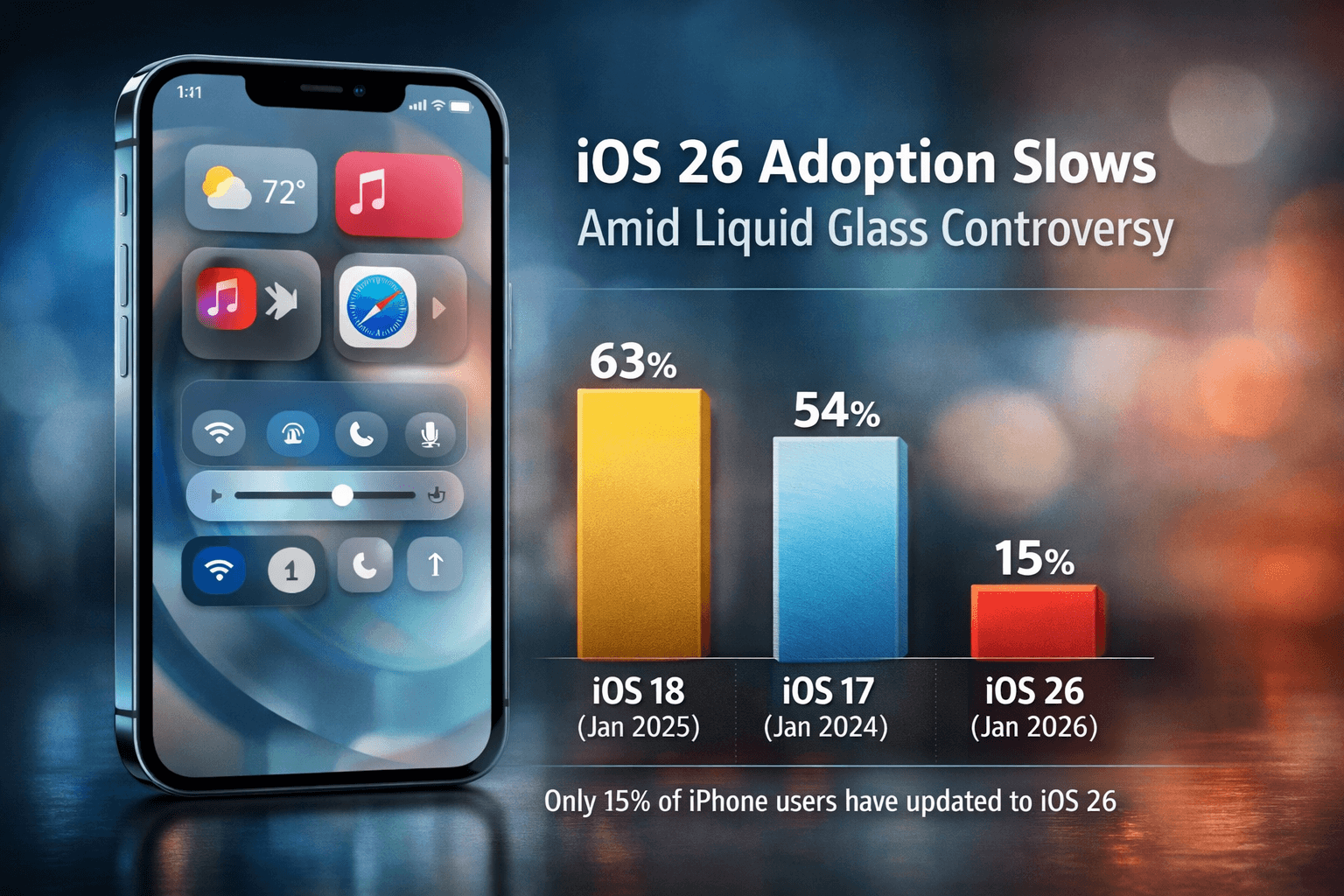
Apple’s latest mobile operating system is facing a rare moment of hesitation from iPhone users. More than three months after its release, iOS 26 has been installed on just over 15 percent of active iPhones worldwide, a sharply slower uptake than previous versions and an early signal that Apple’s bold design changes may not be landing as smoothly as expected.
According to data published by StatCounter for January 2026, adoption of iOS 26 remains historically low for a major Apple software release. The figures were first highlighted by Cult of Mac, which noted that the current rollout pace represents a significant departure from Apple’s typical update cycle.
Source: https://www.cultofmac.com/news/ios-26-adoption-struggles-with-iphone-users
StatCounter data: https://gs.statcounter.com/os-version-market-share/ios/mobile-tablet/worldwide#monthly-202601-202601-bar
Adoption Lags Far Behind Recent iOS Releases
In previous years, Apple users moved quickly to new versions of iOS. By January 2025, roughly four months after launch, iOS 18 had already reached about 63 percent adoption. A year earlier, iOS 17 crossed the 54 percent mark over a similar timeframe.
By contrast, iOS 26’s adoption rate is roughly four times slower than iOS 18 at the same stage. While Apple does not publish official installation figures, StatCounter’s estimates are widely used in the industry and are compiled from usage data collected across apps and websites that integrate its analytics tools.
The unusually wide gap has raised questions among developers, designers, and analysts about what is driving user reluctance this time. According to reports, the answer may lie less in performance or compatibility issues and more in aesthetics.
Liquid Glass Marks Apple’s Biggest Visual Shift in Years
Apple introduced iOS 26 in September with Liquid Glass, a system-wide design overhaul that applies translucent, glass-like layers across the interface. The effect is visible throughout the operating system, from the Home Screen and Control Center to core apps such as Apple Music and Safari.
The redesign represents Apple’s most aggressive visual change since the flat design language introduced with iOS 7 more than a decade ago. Liquid Glass emphasizes depth, blur, and transparency, aiming to create a more immersive and spatial user experience.
Apple has not publicly commented on adoption figures, but the company framed Liquid Glass as a long-term design foundation during its product presentations. According to Apple, the new aesthetic is intended to unify hardware and software more closely and prepare the interface for future device categories.
However, early user reactions suggest that the shift has divided opinion.
Mixed User Response Fuels Hesitation
Since iOS 26’s release, social media platforms and online forums have been filled with debate over Liquid Glass. Some users have praised the redesign for feeling modern and expressive, particularly on newer devices with OLED displays. Designers within Apple-focused communities have also highlighted the visual consistency across apps.
Others have been far less enthusiastic. On Reddit and other discussion boards, critics have described the interface as distracting or visually overwhelming. One widely shared post referred to the redesign as an embarrassment, reflecting frustration rather than technical failure.
This split reaction appears to be influencing upgrade decisions. Unlike previous iOS releases that offered incremental visual changes, iOS 26 alters the daily experience in a way that is immediately noticeable. For users who value familiarity and clarity, that alone may be enough reason to delay.
Customization Options Offer Partial Relief
Apple has provided some flexibility for users uncomfortable with the full Liquid Glass effect. While the design cannot be completely disabled, transparency can be reduced through accessibility settings, and Dark Mode significantly tones down reflective elements. Home Screen customization also allows users to minimize visual clutter.
Even so, analysts note that these workarounds require deliberate effort. For many users, the default experience remains the first impression, and that impression appears to be slowing adoption.
Beyond Design, iOS 26 Brings Practical Updates
Despite the controversy, iOS 26 is not solely about aesthetics. Apple has continued to expand functionality through follow-up updates, including iOS 26.1, which was released in November.
That update introduced broader language support within Apple Intelligence, adding Danish, Dutch, Norwegian, and Turkish. Live Translation features were also expanded, with AirPods gaining real-time translation support for Chinese, Italian, Japanese, and Korean.
Additional improvements include stronger child safety filters, refinements to the Fitness app, and a new “Slide to Stop” gesture for alarms and timers. These changes, while less headline-grabbing than Liquid Glass, address long-standing user requests.
Some analysts believe these practical enhancements may eventually drive adoption upward, particularly as more users upgrade devices or encounter apps that require newer system versions.
Why Adoption Matters to Apple and Developers
Slow adoption is not just a public relations concern for Apple. It has broader implications for developers, who must decide when to target new APIs and design standards. Fragmentation can increase development costs and complicate app testing, particularly when visual changes affect layout and readability.
There is also a strategic dimension. Apple typically uses high adoption rates to justify rapid transitions, such as phasing out support for older hardware or features. A slower rollout could encourage Apple to soften its approach in future updates.
According to industry observers, Apple may also be watching user feedback closely ahead of iOS 27, which could refine or rebalance the Liquid Glass design rather than abandoning it outright.
How Apple’s Core Apps Reflect the Shift
The redesign is especially noticeable in Apple’s own ecosystem. Apple Music, for example, now features layered translucency in playlists and navigation elements, reinforcing the Liquid Glass identity.
Reference: https://uk.pcmag.com/services-players/67157/apple-music
Safari has also adopted the new visual language, with transparent address bars and floating controls that echo trends seen across modern browsers.
Reference: https://uk.pcmag.com/browsers/131976/chrome-edge-firefox-opera-or-safari-which-browser-is-best
These changes highlight how deeply integrated Liquid Glass is within iOS 26, making it unlikely that Apple will reverse course quickly.
Historically, iOS adoption tends to accelerate after the holiday season, as new devices enter the market. February and March data may offer clearer insight into whether iOS 26’s slow start is a temporary pause or a more lasting shift in user behavior.
If adoption remains sluggish, Apple could respond by further refining visual defaults or emphasizing functional improvements in future updates. For now, iOS 26 stands as a rare example of Apple prioritizing bold design experimentation over immediate mass acceptance.
iOS 26’s early adoption figures underscore a growing tension between innovation and familiarity within Apple’s ecosystem. While Liquid Glass represents a confident design statement, it has also prompted many users to pause before updating. Whether that hesitation fades or hardens will help shape Apple’s software strategy in the years ahead.
Add a Comment