


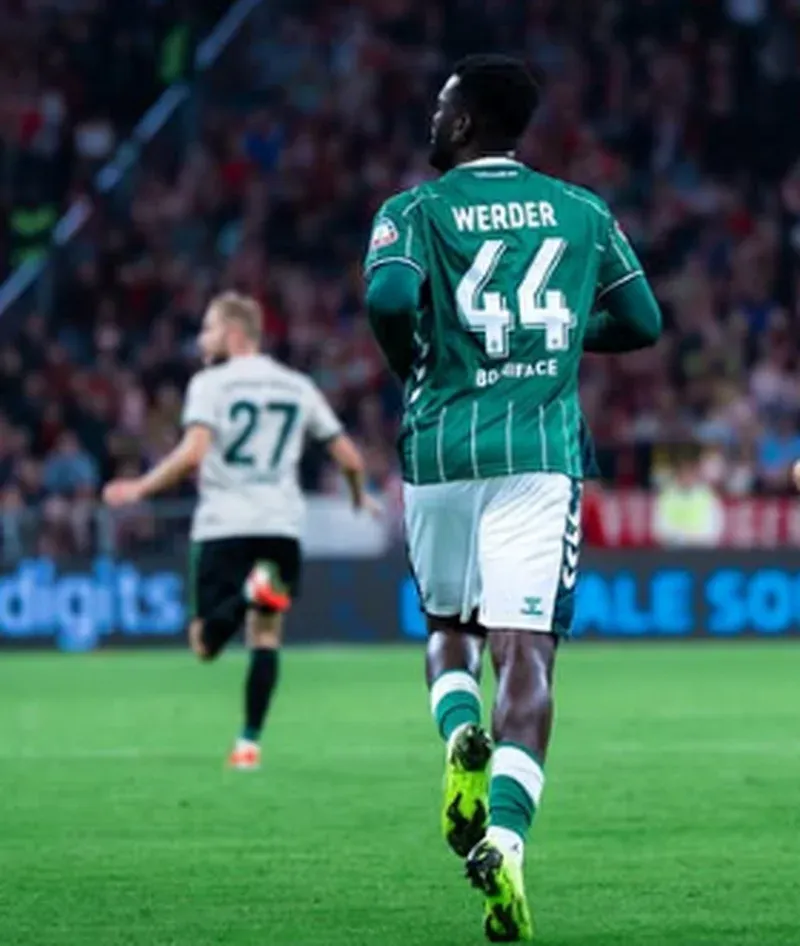
Victor Boniface missed 17 Bundesliga matches after suffering another knee injury in December 2025. By the time he returned to fitness, Werder Bremen had already stabilized their season without him.
That sequence now frames questions around the club’s handling of the Nigerian striker’s loan spell from Bayer Leverkusen. Boniface arrived at the Weserstadion during the 2025 summer transfer window with expectations that he would strengthen Bremen’s attack. Instead, his season ended with zero goals, two assists, and no appearances after recovering from injury.
Boniface made 11 Bundesliga appearances before the injury setback. According to club records and Bundesliga match reports, he failed to score during that period while providing only two assists. His knee injury in December then sidelined him for approximately four months.
Werder Bremen entered a stretch of fixtures that included Bayern Munich, Borussia Dortmund, Leipzig, Bayer Leverkusen, and Eintracht Frankfurt without the Nigerian forward available. Boniface also missed matches against Hoffenheim, Freiburg, Mainz, Wolfsburg, Augsburg, Hamburg, Stuttgart, Union Berlin, Heidenheim, St. Pauli, Borussia Mönchengladbach, and 1. FC Köln.
Peter Niemeyer, Werder Bremen’s Head of Professional Football, later acknowledged that the club deliberately lowered expectations around Boniface’s reintegration after his recovery. Speaking to German outlet DeichStube, Niemeyer said the club viewed the striker primarily as emergency depth rather than an immediate solution.
“We deliberately didn't raise expectations too high,” Niemeyer said. “It was more about having an additional option in case of emergency.”
Football executives rarely describe a returning player as contingency cover unless concerns already exist about fitness, readiness, or tactical suitability. Niemeyer’s comments suggest Bremen had concluded that Boniface, despite being medically cleared, was unlikely to regain competitive sharpness quickly enough to influence the closing weeks of the campaign.
The club’s league position shaped that calculation.
Related News
Werder Bremen ultimately secured Bundesliga survival without needing to reinsert Boniface into active competition. Once relegation pressure eased, the incentive to risk a recently recovered striker diminished further. Clubs facing financial and sporting pressure often prioritize stability over experimentation during the final weeks of a season.
But the loan move leaves unresolved questions for Bayer Leverkusen.
Boniface arrived in Bremen needing consistent minutes after falling down the pecking order at Leverkusen. Instead, the loan produced limited output and another significant injury interruption. Knee problems have repeatedly complicated the striker’s momentum during a period when both club and national team managers needed evidence of sustained fitness.
Availability became the larger issue.
The Nigerian international’s absence from 17 league fixtures meant Bremen effectively operated most of the campaign without the attacking reinforcement they believed they had secured during the summer transfer window. Loan deals are typically designed to solve immediate squad deficiencies. In Boniface’s case, the arrangement became an exercise in squad preservation rather than attacking production.
Our analysis of Bremen’s fixture list shows Boniface missed matches against six clubs that finished in the Bundesliga’s upper competitive tier during the period of his recovery absence. Those were fixtures where rotational depth often becomes most valuable because injuries and suspensions accumulate late in the season.
Yet he still never returned to the pitch.
That decision indicates Bremen’s coaching staff did not view his condition, rhythm, or tactical adaptation as sufficient even after medical clearance. Match fitness and training fitness are treated differently inside elite clubs. Players can return to full training weeks before coaching staffs trust them in competitive matches.
Niemeyer’s remarks also reflect the financial caution now shaping mid-table Bundesliga clubs.
Werder Bremen do not operate with Bayern Munich’s wage flexibility or Bayer Leverkusen’s transfer budget. Loan signings are frequently low-risk bets tied to short-term needs. When injuries interrupt those plans, clubs often reduce expectations quietly rather than publicly framing the move as unsuccessful.
Neither Niemeyer nor Bremen’s coaching staff publicly questioned Boniface’s professionalism or recovery process. The messaging remained careful throughout the final months of the campaign. That restraint matters because clubs still protect asset relationships, especially when dealing with loan players owned by rival Bundesliga teams.
Boniface’s parent club, Bayer Leverkusen, has not publicly detailed how the striker fits into its long-term plans after the loan spell. Squad competition remains intense at Leverkusen, where attacking depth has been built around tactical flexibility and pressing intensity. A player returning from repeated knee issues enters that environment with limited margin for another disrupted season.
Nigeria’s national team staff will also monitor the situation closely.
Super Eagles managers have increasingly faced availability concerns involving European-based forwards during compressed international windows. Boniface remains one of Nigeria’s most physically imposing attacking options when healthy. But recurring interruptions reduce continuity at both club and international levels.
The medical timeline now matters more than reputation.
We reviewed Boniface’s publicly documented absence list and found he missed 17 consecutive Bundesliga fixtures after the December injury setback. That span covered roughly four months of competitive football, enough time for tactical systems and attacking hierarchies to change without him.
By then, Bremen had moved on.
Victor Boniface missed 17 Bundesliga matches after suffering another knee injury in December 2025.
Peter Niemeyer admitted Werder Bremen brought the Nigerian striker back mainly as emergency squad depth, not as an expected starter.
Boniface returned to fitness before the season ended but never played another competitive match for Bremen.
Bayer Leverkusen now faces questions about how Boniface fits into its plans after a loan spell that produced no goals in 11 appearances.
Why didn’t Werder Bremen play Boniface after he recovered?
Because the club had already stabilized its Bundesliga position. Niemeyer said Bremen viewed him mainly as backup depth late in the season, not as an immediate solution.
Was Boniface fully fit before the season ended?
Medically, he had returned from injury. Competitive readiness is different. Coaches often hold players back if match sharpness or conditioning still looks incomplete.
Does this affect his Super Eagles future?
Potentially. National team coaches usually want players getting regular minutes at club level. Long injury absences make squad selection decisions harder, especially before major tournaments.
The unresolved issue now shifts back to Bayer Leverkusen, where club officials must decide whether Boniface remains part of the first-team attacking rotation for the 2026 campaign or becomes available for another transfer move. No transfer fee dispute has emerged publicly. Yet the player’s competitive role, and his ability to stay healthy long enough to reclaim it, remains unsettled heading into preseason preparations.
Add a Comment