


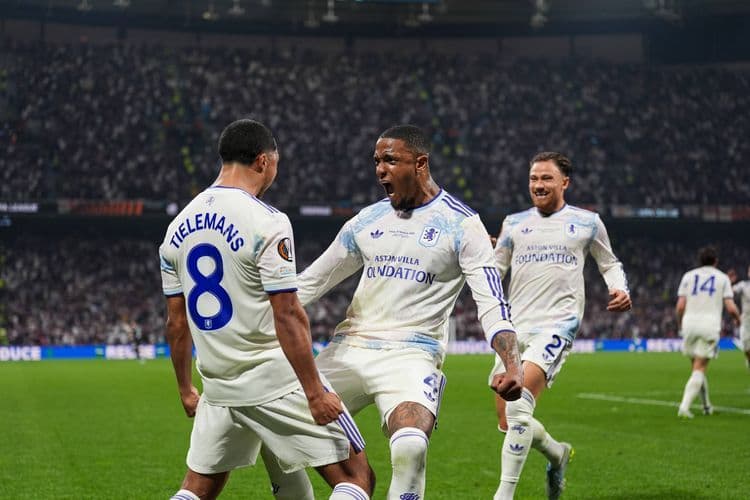
Aston Villa won 3-0 in Istanbul on Wednesday night. The result ended the English club’s 30-year wait for a major trophy and handed manager Unai Emery a fifth UEFA Europa League title, the most by any coach in the competition’s history.
But buried beneath Villa’s celebration at the Beşiktaş Stadium was a statistical detail that kept Nigeria unexpectedly central to the conversation. According to Opta data released after the final, Nigerian players have scored more goals in Europa League finals over the last decade than players from any other nationality.
Villa’s victory over SC Freiburg featured goals from Belgian midfielder Youri Tielemans, Argentine attacker Emiliano Buendía, and English winger Morgan Rogers. Tielemans’ strike moved Belgium to four Europa League final goals in the past ten finals. Nigeria remain ahead with five.
The statistic is unusual because Nigeria has not produced a Europa League finalist every season, nor has the country dominated the competition structurally. English, Spanish, and Italian clubs still control most of the tournament’s commercial and sporting power. Yet Nigeria’s numbers come from decisive moments by three different players across three separate finals.
Alex Iwobi scored Arsenal’s only goal during their 4-1 defeat to Chelsea FC in the final staged in Baku. Arsenal lost heavily, but Iwobi’s late strike became Nigeria’s first contribution to the current statistical run.
Three years later, another Nigerian player delivered under similar pressure. Joe Aribo opened scoring for Rangers FC in the 2022 final against Eintracht Frankfurt. Rangers eventually lost on penalties after a 1-1 draw in Seville.
Nigeria separated itself from every other country in 2024 because of one performance. Ademola Lookman scored all three goals for Atalanta BC during their 3-0 victory over Bayer 04 Leverkusen in Dublin.
Lookman became the first player to score a hat trick in a single-leg Europa League final. UEFA records also confirmed he became the first African player to score three goals in a major European club final. The defeat simultaneously ended Bayer Leverkusen’s 51-match unbeaten run under manager Xabi Alonso.
Related News
We reviewed UEFA’s official match data from the Dublin final, and Lookman completed 16 successful final-third actions alongside three shots on target, all converted into goals. That efficiency level rarely appears in European finals, where chance conversion rates typically collapse under pressure.
His first goal came from close-range movement inside the penalty area. The second arrived after he isolated midfielder Granit Xhaka before curling a left-footed strike beyond the goalkeeper from distance. The third came during a counterattack that exposed Leverkusen’s high defensive line late in the second half.
Belgium’s four-goal tally across the same ten-final period came through Tielemans, Eden Hazard and Romelu Lukaku. Belgium’s total carries more breadth in terms of appearances by elite clubs and players. Nigeria’s advantage rests heavily on Lookman’s night in Dublin.
The Europa League has historically rewarded clubs from Europe’s larger football economies. Nigerian players rarely enter finals as centrepieces of the commercial narrative surrounding those matches. Yet in decisive scoring moments, Nigerian forwards and attacking midfielders have repeatedly shaped outcomes.
Opta’s count tracks goals scored in finals only. It does not measure total tournament goals, assists, appearances, or minutes played across the Europa League era. Countries such as Spain, England, and France still dominate broader production metrics because their domestic clubs reach latter stages more consistently.
A single decisive goal in a European final carries disproportionate historical weight because it survives longer in public recall than group-stage statistics. That partly explains why Lookman’s performance against Leverkusen continues to shape discussions around Nigerian football despite Atalanta’s smaller global profile compared to clubs like Arsenal, Liverpool, or Sevilla.
Villa’s victory in Istanbul also contained a Nigerian subplot that ended quietly. Freiburg goalkeeper Noah Atubolu, who is eligible to represent Nigeria internationally, finished on the losing side after conceding three goals in the final.
The decision around his international future remains unresolved.
Nigeria’s national team continues to track dual-nationality players across Europe as the Nigeria Football Federation attempts to deepen squad depth ahead of upcoming qualification campaigns. Atubolu has represented Germany at youth level, but FIFA eligibility rules still leave room for a senior switch under certain conditions.
Villa’s triumph also strengthened Emery’s standing within European competition history. The Spanish coach has now won Europa League titles with Sevilla, Villarreal, and Aston Villa. No manager has lifted the trophy more times since UEFA restructured the competition from the old UEFA Cup format in 2009.
Yet the statistical footnote that survived the night belonged elsewhere. Nigeria, without a finalist of its own in Istanbul, still left the competition leading the modern Europa League final scoring table.
Nigeria still lead all countries with five Europa League final goals across the last ten finals.
Ademola Lookman’s 2024 hat trick against Bayer Leverkusen remains the single biggest reason for Nigeria’s lead.
Aston Villa’s 3-0 win in Istanbul moved Belgium closer, but Youri Tielemans only cut the gap to one goal.
Noah Atubolu’s appearance for Freiburg reopened questions about whether Nigeria can recruit more dual-nationality players.
Why does Nigeria top the table with only a few players?
Because the statistic counts final goals only. Lookman scored three alone in 2024. Iwobi and Aribo added one each. That is enough to lead the category.
Did Aston Villa have any Nigerian players?
No senior Nigerian international played for Villa in the final. The Nigerian connection came through Freiburg goalkeeper Noah Atubolu, who is eligible for Nigeria.
Is this an official UEFA record?
The nationality ranking itself was circulated through Opta statistics after the final. UEFA separately confirms the individual records, including Lookman’s hat trick in Dublin.
The next unresolved issue sits with international eligibility rather than club football. FIFA statutes still permit Noah Atubolu to switch national allegiance under specific conditions, but neither the Nigeria Football Federation nor the German Football Association has publicly clarified his long-term status before the next international registration window opens later this year.
Add a Comment