

Login to view saved posts

Login to view saved posts
Posted by
Ezinwa
•Jan 7, 2026
Jan 7, 2026
The United States has rolled out a new visa bond policy that will require many Nigerian travellers and citizens of 37 other countries to post significant financial guarantees before receiving short-term U.S. visas, marking one of the most stringent changes to visitor entry rules in recent years.
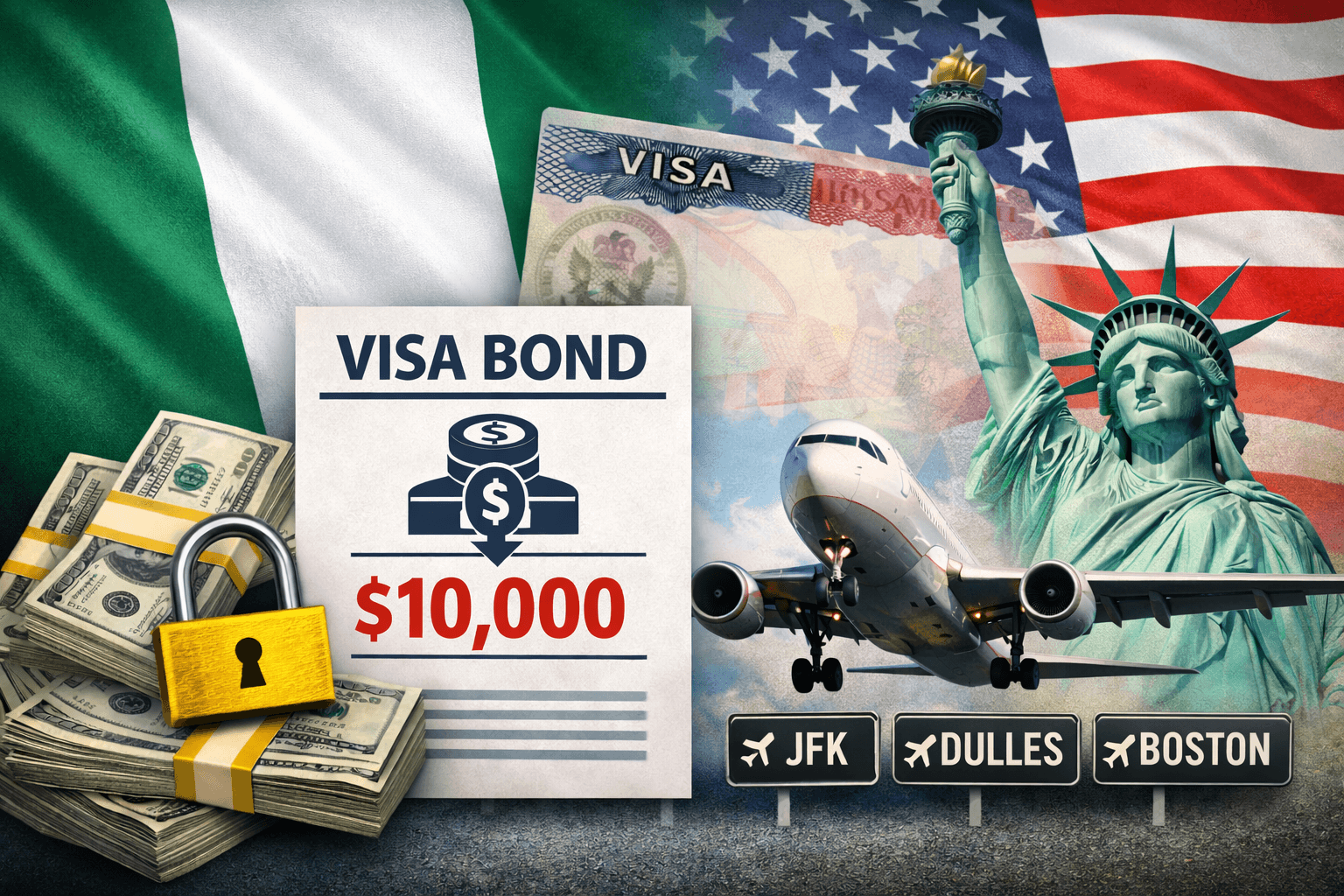
According to the U.S. Department of State, the policy affects certain applicants seeking B1 and B2 visas, which cover business and tourism travel. Nigerians subject to the measure will be required to pay a refundable bond of between $5,000 and $15,000, depending on the outcome of their visa interview. The requirement for Nigerian applicants is scheduled to take effect on January 21, 2026.
U.S. officials say the initiative is part of a pilot programme designed to curb visa overstays and reinforce compliance with immigration rules, particularly among nationals of countries with historically higher rates of overstaying visitor visas.
Under the new framework, consular officers will determine whether an applicant must post a bond and, if so, the amount required. The assessment will be based on factors reviewed during the visa interview, though the Department of State has not publicly detailed the exact criteria used to set bond levels.
Applicants directed to post a bond must complete the Department of Homeland Security Form I-352, known as the Immigration Bond form. Payments are to be made solely through Pay.gov, the official U.S. Treasury payment platform.
The U.S. government has issued a clear warning against using third-party agents or unofficial websites, noting that payments made outside approved systems will not be recognised and will not qualify for refunds.
Officials also stressed that posting a bond does not guarantee visa approval. Applications can still be denied even after the bond is paid, reinforcing the discretionary nature of U.S. visa decisions.
Beyond the financial requirement, the policy imposes new travel limitations on affected visa holders. Those who post bonds will be permitted to enter and exit the United States only through three designated airports: John F. Kennedy International Airport in New York, Washington Dulles International Airport in Virginia, and Boston Logan International Airport in Massachusetts.
According to the Department of State, failure to comply with the designated port-of-entry rule could result in denied admission or problems with departure records. Such issues may trigger penalties under the bond agreement, including forfeiture of the bond.
Immigration analysts say the airport restriction is an unusual feature that suggests closer monitoring of arrivals and departures. According to U.S. immigration lawyer David Leopold, the limited entry points may allow authorities to better track compliance during the pilot phase, though it also adds logistical and financial burdens for travellers whose final destinations lie elsewhere in the country.
The State Department said visa bonds will be cancelled and refunded automatically if travellers comply fully with the terms of their stay. This includes departing the United States on or before the authorised period expires, choosing not to travel before the visa expires, or being denied entry at the port of arrival.
However, the bond may be breached if a visitor overstays, fails to depart, or attempts to change immigration status while in the United States. This includes applying for asylum or other forms of immigration relief. In such cases, the matter may be referred to U.S. Citizenship and Immigration Services for enforcement action.
According to the Department of State, bond breaches could carry long-term consequences beyond financial loss, including potential impacts on future visa eligibility.
Nigeria is among 38 countries whose nationals are covered by the new policy. Other African nations on the list include Benin, Togo, Senegal, Uganda, Zimbabwe, Algeria, Angola, Zambia, and Ghana’s immediate neighbours Benin and Togo.
Countries in Asia, the Caribbean, and Latin America are also affected, though U.S. officials have not released a consolidated public list explaining the selection criteria for each country.
Implementation dates vary by country, with some nationals facing the new rules as early as August 2025. For Nigerians, the January 2026 start date provides a short adjustment window for prospective travellers.
Importantly, U.S. authorities clarified that the bond requirement applies regardless of where the visa application is submitted. This means Nigerian citizens applying for U.S. visas from embassies or consulates outside Nigeria will still be subject to the policy.
Visa bonds are not entirely new to U.S. immigration law, but they have rarely been applied at scale in recent decades. Section 221(g)(3) of the Immigration and Nationality Act allows the U.S. government to require financial guarantees in cases where there are concerns about compliance with visa conditions.
The renewed use of bonds reflects growing political and administrative pressure in Washington to address visa overstays, which U.S. authorities say account for a significant share of undocumented migration. According to past Department of Homeland Security reports, visitor overstays have consistently exceeded illegal border crossings as a source of new undocumented residents.
Analysts note that the pilot programme aligns with broader efforts by U.S. immigration agencies to tighten controls without formally reducing visa quotas or issuing blanket bans.
Travel to the United States remains popular among Nigerians for business, education-related visits, medical care, and family connections. The new bond requirement introduces a substantial financial hurdle that could discourage legitimate short-term travel, particularly for middle-income applicants.
According to Lagos-based travel consultant Bola Adebayo, the policy may shift travel patterns. “For many Nigerians, tying up $10,000 or more for months is simply not practical,” she said. “Even if the bond is refundable, the opportunity cost is very high.”
There are also concerns about fairness and transparency. While U.S. officials say the policy is risk-based, the lack of publicly available criteria for bond decisions has raised questions among immigration advocates about consistency and potential bias.
As a pilot programme, the visa bond policy is likely to be closely monitored by U.S. authorities. Officials may expand, modify, or discontinue the scheme depending on compliance data and political feedback.
Observers will also be watching how affected governments respond. While Nigeria has not yet issued an official statement, past changes to U.S. visa rules have prompted diplomatic engagement and negotiations.
For prospective travellers, immigration experts advise early planning, careful documentation, and realistic budgeting. According to reports, further guidance from U.S. embassies is expected closer to each country’s implementation date.
For digital publication, editors may consider a chart showing bond amounts and implementation dates by country, a map highlighting affected regions, or a timeline explaining how visa bonds work from application to refund.
The U.S. decision to require visa bonds from Nigerians and citizens of 37 other countries marks a significant shift in visitor visa enforcement. While framed as a compliance measure rather than a restriction on lawful travel, the policy introduces new financial and logistical barriers that could reshape travel patterns. As implementation begins, both travellers and policymakers will be watching closely to see whether the approach delivers the compliance gains Washington is seeking without discouraging legitimate international visits.
Loading related news...
Add a Comment