


commercial rideshare payloads
A SpaceX Falcon 9 rocket successfully lifted off from Vandenberg Space Force Base in California on January 11, carrying a mix of NASA astrophysics satellites and dozens of commercial spacecraft in a rideshare mission named “Twilight.” The launch occurred at 8:44 a.m. Eastern, with the 40 spacecraft aboard beginning deployment 61 minutes later and concluding over 90 minutes after liftoff.
The Twilight mission is part of SpaceX’s expanding rideshare program, which allows multiple small satellites to share a single launch. Unlike the company’s primary rideshare lines—Transporter missions to sun-synchronous orbit and Bandwagon flights to mid-inclination orbits—Twilight deployed payloads into dusk-dawn sun-synchronous orbits, providing consistent lighting conditions for Earth observation and astrophysics missions.
Commercial payloads dominate the flight
While NASA’s astrophysics satellites drew significant attention, the mission’s primary cargo consisted of commercial spacecraft. These included 10 optical data relay satellites for Kepler Communications and nine Lemur satellites for Spire, a provider of space-based data analytics. Other payloads came from Internet of Things startup Plan-S, radio frequency intelligence company Hawkeye 360, and radar imaging firms Capella Space, Iceye, and Umbra.
Industry analysts note that rideshare missions like Twilight continue to lower the cost of accessing space, allowing smaller commercial operators to deploy satellites efficiently alongside scientific missions. This convergence of commercial and government payloads demonstrates a growing trend of shared infrastructure in low Earth orbit.
NASA astrophysics missions take flight
Three NASA missions were included in the launch, highlighting the agency’s continued push into small satellite astrophysics. Two of these are 6U cubesats:
Star-Planet Activity Research CubeSat (SPARCS): Developed by the University of Arizona, SPARCS will monitor ultraviolet emissions from 20 K- and M-class stars. By studying stellar flares and other activity, the mission aims to assess how such activity may influence the habitability of orbiting exoplanets.
Black Hole Coded Aperture Telescope (BlackCAT): A Penn State University project, BlackCAT will observe X-ray flares from supermassive black holes in active galaxies and detect gamma-ray bursts. Both cubesats were funded through NASA’s astrophysics research and analysis programs.
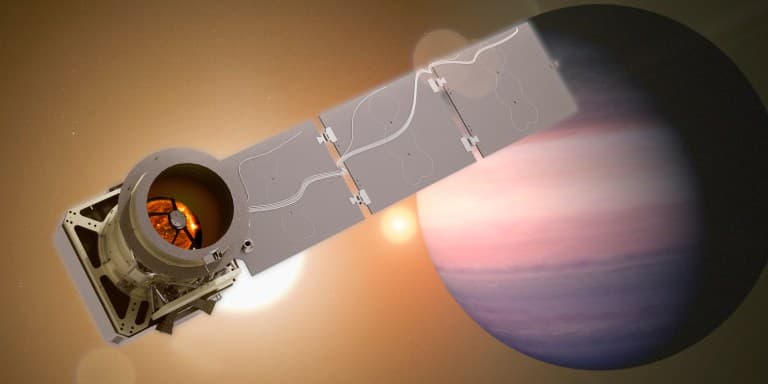
The third mission, Pandora, is a 325-kilogram small satellite under NASA’s Astrophysics Pioneers program, which funds missions with cost caps of $20 million. Equipped with a 45-centimeter telescope, Pandora will study exoplanet atmospheres by observing planetary transits, providing insight into atmospheric composition and structure. Led by NASA’s Goddard Space Flight Center, Pandora marks the second launch from the Pioneers program. Its predecessor, the Payload for Ultrahigh Energy Observations (PUEO), is a balloon-based mission launched over Antarctica in December 2025 to study high-energy particles interacting with Antarctic ice.
Expanding the Pioneers program
Pandora and PUEO were two of four mission concepts selected in 2021 as the first Astrophysics Pioneers missions. The remaining two are Aspera, a spacecraft designed to study galaxy evolution scheduled for launch later this year on a Rocket Lab Electron, and StarBurst, a small satellite mission targeting the early phases of gamma-ray bursts with a projected launch in 2027.
NASA has also approved additional Pioneers missions, including the Trans-Iron Galactic Element Recorder for the ISS (TIGERISS), an instrument to be installed on the International Space Station, and Landolt, an “artificial star” small satellite designed to calibrate stellar brightness measurements for other telescopes.
At a NASA town hall on January 5 during the 247th Meeting of the American Astronomical Society, Shawn Domagal-Goldman, director of NASA’s astrophysics division, confirmed that the agency is preparing to select additional Pioneers missions in 2026. “We are capable of supporting up to two Pioneers missions,” he said, emphasizing that the agency is moving as quickly as possible while balancing technical review and proposal timelines.
Domagal-Goldman also indicated that NASA may slightly delay the next call for proposals. “We are thinking of pushing back the call a little so that teams can respond to what we are about to potentially select,” he said, allowing proposers to adapt and pursue alternative mission concepts.
Why the Twilight launch matters
Twilight reflects several broader trends in space exploration: the increasing integration of commercial and government payloads, the growing utility of small satellites in astrophysics research, and the use of rideshare missions to reduce launch costs. For NASA, rideshare opportunities like Twilight enable relatively low-cost access to space for missions that provide high scientific value, particularly in understanding stellar behavior and exoplanet atmospheres.
Experts highlight that the inclusion of both cubesats and larger small satellites such as Pandora demonstrates NASA’s commitment to a diversified approach, combining quick-deployment cubesats with more capable small spacecraft to answer complex astrophysical questions.
The Twilight mission is expected to provide early science results in the coming months as SPARCS, BlackCAT, and Pandora begin operations in their respective orbits. Analysts will also be monitoring the commercial payloads, particularly in Earth observation and radio frequency intelligence, as these spacecraft continue to fuel the growth of private space infrastructure.
For NASA, the Pioneers program is a proving ground for small, focused missions that complement larger flagship projects while fostering rapid innovation. As the agency selects additional missions later this year, the balance between affordability, agility, and scientific impact will remain a defining feature of the program.
Visual and data ideas
Suggested visuals to accompany this story include an infographic showing the deployment sequence of the 40 spacecraft, a chart of NASA Astrophysics Pioneers missions and launch timelines, and annotated diagrams of SPARCS, BlackCAT, and Pandora. A map of the sun-synchronous orbit used for Twilight could also help readers understand the satellites’ operational environment.
The successful launch of Twilight underscores the growing synergy between commercial and scientific space operations. With NASA’s astrophysics cubesats and small satellites now in orbit, researchers are poised to advance studies of stellar activity, black holes, and exoplanet atmospheres. At the same time, the mission exemplifies how rideshare launches are expanding access to space for both government and commercial operators, marking a new chapter in low Earth orbit activity.
Add a Comment