


President Donald Trump and his national security team are weighing a spectrum of possible responses to the escalating unrest in Iran, including cyber operations and potential military strikes by the United States or Israel, according to two people familiar with internal White House deliberations. The sources spoke on condition of anonymity because they were not authorized to discuss sensitive discussions publicly.
The deliberations come as protests across Iran intensify, security forces continue mass arrests, and Tehran issues increasingly blunt warnings against foreign intervention. At the same time, Trump says Iran has reached out to propose negotiations, creating a volatile mix of diplomacy and confrontation at a moment when tensions are already high.
“The military is looking at it, and we’re looking at some very strong options,” Trump told reporters aboard Air Force One late Sunday. Asked how the United States would respond if Iran retaliated, he added: “If they do that, we will hit them at levels that they’ve never been hit before.”
Talks floated as violence mounts
Trump said his administration is working to arrange a meeting with Iranian officials, but suggested that events on the ground may force Washington to act before any talks take place.
“I think they’re tired of being beat up by the United States,” Trump said, adding that Tehran wants to negotiate. “The meeting is being set up, but we may have to act because of what’s happening before the meeting.”
There was no immediate confirmation from Iranian authorities that they had formally proposed talks. Iranian state media did not acknowledge Trump’s comments, and officials in Tehran have continued to frame the unrest as a foreign-backed plot rather than a domestic uprising.
According to the U.S.-based Human Rights Activists News Agency, more than 10,600 people have been detained during roughly two weeks of demonstrations. The group reported that at least 544 people have died, including 496 protesters and 48 members of the security forces. The organization has been considered credible in past periods of unrest and says it relies on networks inside Iran to cross-check reports.
Independent verification remains difficult. Iran has imposed widespread internet shutdowns and cut phone lines, limiting the ability of journalists and human rights monitors to assess conditions. The Associated Press has said it cannot independently confirm the casualty figures, and Iranian authorities have not released comprehensive death tolls.
Information blackout fuels concern
Human rights advocates and Iranian diaspora groups say the communications blackout may be emboldening hard-liners within Iran’s security services to pursue a more violent crackdown. Despite the restrictions, protests appeared to continue through the weekend in Tehran and other major cities.
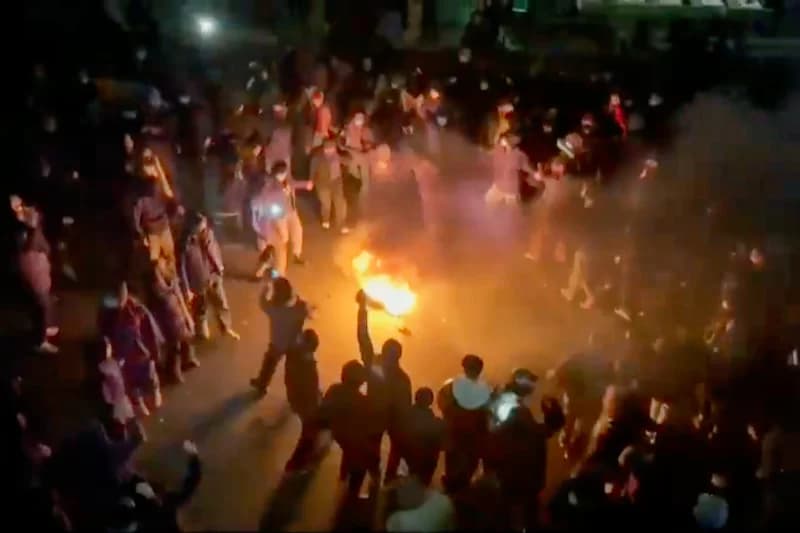
Demonstrators poured into streets in the capital and in Mashhad, Iran’s second-largest city, late Saturday into early Sunday, according to online videos and social media posts shared from inside the country. Additional footage circulated Sunday night into Monday, with at least one Tehran official acknowledging ongoing demonstrations in comments carried by state media.
Videos purportedly from northern Tehran’s Punak neighborhood showed crowds waving illuminated mobile phones while security forces blocked streets. Other clips appeared to show fireworks and the sound of metal objects being struck in defiance. In Mashhad, footage suggested confrontations between protesters and security personnel. Smaller demonstrations were also reported in cities including Kerman.
Iranian state television attempted to project calm by broadcasting footage from selected neighborhoods in several cities on Sunday morning, complete with on-screen timestamps. Notably absent were live reports from Tehran and Mashhad, the focal points of much of the unrest.
Defiant rhetoric in parliament
Against this backdrop, Iran’s parliament struck a defiant tone. Mohammad Baagher Qalibaf, the hard-line speaker of the legislature and a former presidential candidate, warned that U.S. and Israeli forces would be targeted if Iran is attacked.
“In the event of an attack on Iran, both the occupied territory and all American military centers, bases and ships in the region will be our legitimate targets,” Qalibaf said in a speech to lawmakers, using a term Iranian officials commonly employ to refer to Israel. He added that Iran would not wait to be struck first if it perceived an imminent threat.
His remarks were met with chants of “Death to America” from lawmakers, some of whom rushed toward the parliamentary dais in a display of unity and defiance.
Analysts note that such rhetoric plays well with Iran’s hard-line base but may also be intended as a deterrent message to Washington and its allies. Still, it remains unclear how far Tehran is prepared to go. Iran’s air defenses were badly damaged during a 12-day conflict with Israel in June, and any major military decision would ultimately rest with Supreme Leader Ayatollah Ali Khamenei, who is 86.
U.S. and allies on heightened alert
The U.S. military says it has positioned forces across the Middle East to defend American personnel and interests. Iran targeted U.S. forces at Al Udeid Air Base in Qatar in June, underscoring the risk of escalation. The U.S. Navy’s 5th Fleet remains headquartered in Bahrain, a key hub for regional operations.
A large U.S. military deployment to the Caribbean is also being factored into planning, according to officials familiar with the discussions. While unrelated geographically, the deployment reflects broader concerns about global force readiness and deterrence as multiple crises unfold.
Israel, for its part, is closely monitoring developments. An Israeli official, speaking anonymously because they were not authorized to brief reporters, said Prime Minister Benjamin Netanyahu discussed Iran overnight with U.S. Secretary of State Marco Rubio. Netanyahu later praised the courage of Iranian protesters, calling their actions a source of global admiration.
International reactions grow
The crisis has drawn reactions from global leaders and institutions. At the Vatican, Pope Leo XIV cited Iran as a place “where ongoing tensions continue to claim many lives,” urging patience, dialogue, and peace.
The United Nations said Secretary-General Antonio Guterres was “shocked” by reports of violence against demonstrators and called on Iranian authorities to exercise maximum restraint and restore communications. Demonstrations in support of Iranian protesters were also held in several international capitals over the weekend.
Roots of the unrest
The protests began on Dec. 28, initially sparked by the collapse of Iran’s currency. The rial is trading at more than 1.4 million to the U.S. dollar, reflecting deep economic strain driven by international sanctions and long-standing structural problems. The sanctions are tied in part to Iran’s nuclear program, which remains a major point of contention between Tehran and Western powers.
What started as economic grievances has since broadened into direct challenges to Iran’s theocratic system, a shift that alarms the country’s leadership and helps explain the severity of the response.
Why this moment matters
The convergence of mass protests, a rising death toll, and conflicting signals about diplomacy has placed the United States at a critical decision point. Acting too forcefully risks unifying Iran’s leadership and triggering regional conflict. Waiting too long could weaken Washington’s leverage and embolden hard-liners in Tehran, according to regional analysts.
What happens next may hinge on whether back-channel diplomacy gains traction or whether events on the streets outpace negotiations. For now, both sides appear to be testing each other’s resolve, with protesters caught in the middle.
Add a Comment