


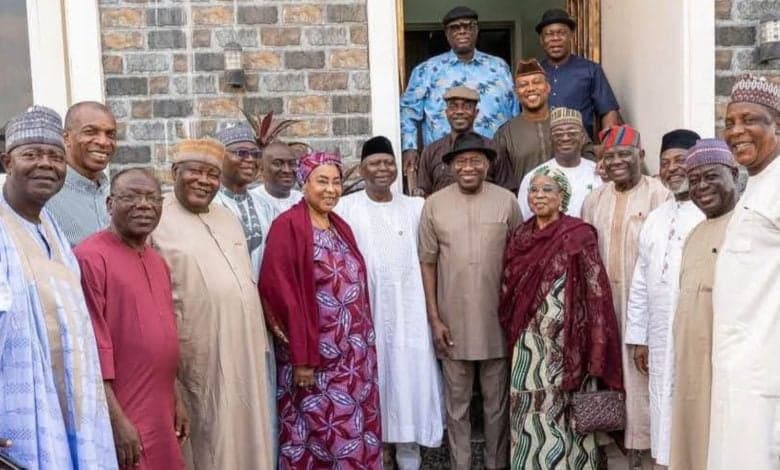
A breakaway faction of the Peoples Democratic Party has submitted former President Goodluck Jonathan's name to INEC as its 2027 presidential candidate, bypassing the commission's electronic portal entirely.
The submission deepens a leadership crisis that has left Nigeria's main opposition party without a single, undisputed structure heading into the next general election. Two competing PDP factions now claim legal authority to field candidates, a dispute that could determine whether the party appears on the ballot in any coherent form.
The Interim National Working Committee, led by Kabiru Turaki, a Senior Advocate of Nigeria, announced the submission at a press conference in Abuja on Thursday night. National Publicity Secretary Ini Ememobong told reporters the faction filed Jonathan's name along with lists of governorship, National Assembly and State Assembly candidates nationwide.
The filing was manual, not electronic. Ememobong said INEC never issued the access codes needed to use the commission's submission platform. "Notwithstanding INEC's refusal to provide us with the necessary access codes, we have successfully submitted, manually and in full compliance with the Electoral Act 2026, the list of candidates sponsored by the authentic Peoples Democratic Party," he said.
That single word, "authentic," is the crux of the dispute. Ememobong's faction insists it is the only legitimate leadership of the PDP. INEC, according to Ememobong, disagrees, at least enough to withhold the electronic credentials the faction says it needed.
How the Faction Says It Formed
Ememobong traced the group's authority to a gap left by prior court rulings. He said those decisions created a vacuum in the party's national leadership structure, though he did not name the specific case or cite a court citation at the press conference.
Into that vacuum, he said, stepped the party's Board of Trustees. The Board convened a National Executive Committee meeting through what Ememobong called a "member requisition," a mechanism that allowed members to call the meeting directly rather than wait for existing officers to do so. That meeting produced the interim leadership arrangement now headed by Turaki.
Related News
Whether that process satisfies PDP's constitution or Nigeria's Electoral Act is a legal question, not one Ememobong's press conference resolved. No document from the Board of Trustees was made public alongside Thursday's announcement, and no independent verification of the "member requisition" process was offered.
The Court Filing
The faction did not stop at INEC. Ememobong disclosed that the group has approached the Federal High Court in Abuja, seeking recognition after INEC allegedly declined to acknowledge the interim leadership. He said INEC ignored formal notifications the faction had sent about its own emergence as a leadership structure.
No case number, filing date, or presiding judge was given at the press conference. That leaves the Federal High Court's docket, and any INEC response, as the next concrete markers in this dispute rather than anything settled Thursday night.
Jonathan's Position Unclear
Nothing in Ememobong's remarks indicates that Jonathan himself confirmed acceptance of the nomination. The statement describes a name submitted to INEC. It does not describe a formal acceptance speech, a signed consent form, or any public remarks from the former president addressing the submission.
That gap matters. Nigerian electoral law generally requires a candidate's own consent as part of a valid nomination. Whether Jonathan has given that consent, in writing or otherwise, was not addressed in the material reviewed for this report.
A Party Split in Two
The submission comes amid a wider PDP leadership fight that has played out for months. NAN's dispatch does not detail every prior stage of that fight, but it does establish that rival claims to party leadership have already reached the courts once, producing the ruling Ememobong says created the current vacuum.
That earlier ruling is itself unnamed in the material available. Its outcome, according to Ememobong, was structural: no clear national leadership left in its wake. Whether other PDP figures accept that reading, or whether a rival faction has also submitted its own presidential candidate to INEC by Thursday's deadline, is not addressed in Ememobong's remarks.
What INEC Has Not Said
INEC's own position is conspicuously absent from the record. Ememobong describes the commission's alleged refusal to issue access codes and its alleged failure to respond to notifications about the interim leadership. But no statement from INEC, spokesperson or otherwise, appears in the material reviewed alongside Ememobong's press conference.
That silence is the story's most important unresolved thread. INEC's own submission portal and its own recognition process will determine which PDP list, if either, gets accepted for 2027. A commission that has not yet spoken publicly could still reject the manually filed list outright, accept it provisionally pending the Federal High Court case, or wait for a court ruling before acting at all.
The Federal High Court in Abuja has not yet ruled on the faction's request for recognition. No hearing date was disclosed at Thursday's press conference. Until INEC responds publicly, or the court schedules a hearing, the manually submitted list carries no confirmed legal status, leaving Nigeria's opposition party, and its presidential ticket, in the same limbo Ememobong says his faction was trying to resolve.
Add a Comment