


Manchester United Sack Ruben Amorim with New Interim Head Coach Named
Posted by
Azuka
•Jan 5, 2026
Jan 5, 2026
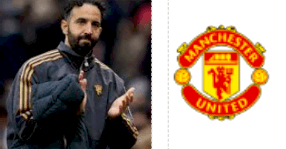
Manchester United have dismissed head coach Ruben Amorim after just over a year in charge, bringing an abrupt end to a tenure that promised tactical innovation but ultimately delivered mounting tension and inconsistent results.
The club confirmed the decision on Monday in a brief statement, announcing that Darren Fletcher will take temporary charge of the first team, starting with Wednesday’s Premier League fixture against Burnley.
According to the statement, Amorim, who was appointed in November 2024, has officially departed his role with immediate effect.
“Ruben Amorim has departed his role as Head Coach of Manchester United,” the club said. “Ruben was appointed in November 2024 and led the team to a UEFA Europa League
Final in Bilbao in May.
“With Manchester United sitting sixth in the Premier League, the club’s leadership has reluctantly made the decision that it is the right time to make a change. This will give the team the best opportunity of the highest possible Premier League finish. The club would like to thank Ruben for his contribution to the club and wishes him well for the future.”
United later confirmed that Fletcher, currently a senior coach and technical figure within the club, will oversee the side on an interim basis. According to a report by David Ornstein, Fletcher is expected to remain in charge until the end of the season.
Results and pressure at the halfway point
The decision comes with United sixth in the Premier League table just past the halfway point of the campaign, a position that falls short of preseason ambitions set by the club’s hierarchy and new ownership structure.
Recent results have done little to ease the pressure. United closed the calendar year with an unconvincing home draw against Wolves before settling for another stalemate away to
Leeds United on Sunday. While the team remains within touching distance of the top four, performances have lacked consistency, identity, and momentum.
Amorim leaves Old Trafford as the club’s 10th permanent manager since the retirement of Sir Alex Ferguson in 2013, a statistic that continues to underline the instability that has defined United’s post-Ferguson era.
Growing tensions behind the scenes
According to multiple reports, Amorim’s departure was influenced as much by internal dynamics as by on-field results.
Relations between the Portuguese coach and the club’s leadership had reportedly deteriorated in recent weeks, with tensions escalating between Amorim and director of football Jason Wilcox. Sources familiar with the situation say discussions over recruitment strategy, squad balance, and long-term planning became increasingly strained, eventually reaching breaking point.
Those close to the club describe a disconnect between Amorim’s tactical demands and the profiles of players recruited under the current structure, led by INEOS, the minority owners now overseeing football operations.
A system without the tools
Amorim arrived in Manchester with a reputation as a coach wedded to a distinct tactical identity, shaped by his success in Portugal. His preference for a structured system, built around specific positional roles and automatisms, was seen as both a strength and a risk.
In practice, that risk became increasingly apparent. United often appeared caught between systems, with players struggling to adapt to roles that did not naturally suit their attributes. The lack of tailored recruitment further complicated matters.
Major questions are now being asked about the club’s decision-making under INEOS. Critics argue that appointing a coach with a highly defined philosophy, while simultaneously pursuing a recruitment model that prioritises long-term asset value over system fit, created an almost inevitable clash.
That tension surfaced publicly after Amorim’s final match in charge, when he spoke candidly following the draw at Leeds United.
“I came here to be the manager of Manchester United,” Amorim said. “Not to be the coach of Manchester United. And that is clear.”
The comment was widely interpreted as a reference to limits placed on his authority and influence, particularly in transfer strategy and squad planning.
A record that told its own story
From a statistical standpoint, Amorim’s reign struggled to justify patience. His win percentage of just 32 percent ranks among the lowest of any United manager in the modern era.
While previous post-Ferguson coaches also failed to deliver sustained title challenges, most at least maintained United within the top-four conversation. Under Amorim, the club spent extended periods drifting around mid-table, with little sense of progression or cohesion.
Reaching the Europa League final in Bilbao last May stands out as the high point of his tenure, offering a glimpse of what might have been possible. However, that run ultimately proved the exception rather than the foundation of sustained success.
What Fletcher’s interim role means
Darren Fletcher’s appointment as interim head coach offers continuity rather than revolution. A former United midfielder with deep institutional knowledge, Fletcher has been closely involved in the club’s football operations and is viewed internally as a steadying presence.
According to reports, his brief is not to overhaul tactics but to stabilise performances, restore confidence, and maximise league position over the remaining months of the season.
Analysts suggest Fletcher’s familiarity with the squad and reduced political baggage could help ease dressing room tensions in the short term, even if a permanent appointment is unlikely.
What happens next at Old Trafford
Amorim’s departure once again raises fundamental questions about Manchester United’s long-term direction.
Since INEOS became part-owners, the club has spoken repeatedly about coherence, structure, and modernisation. Yet the last two years have been marked by strategic missteps, from unclear recruitment priorities to misaligned managerial appointments.
Football analysts note that United now face a crucial decision. Either the club commits fully to a manager whose philosophy aligns with its recruitment model, or it reshapes that model to properly support a coach with strong tactical convictions.
The next appointment, permanent or otherwise, will be seen as a defining test of whether lessons have been learned.
Why this moment matters
With European qualification still within reach and financial implications tied to league position, United’s leadership clearly felt change was necessary now rather than in the summer.
However, Amorim’s exit also reinforces a familiar pattern at Old Trafford, where managers absorb the consequences of broader structural failures.
As the season enters its decisive phase, attention will turn not only to results under Fletcher, but to whether United’s hierarchy can finally deliver alignment between vision, recruitment, and coaching.
Until then, the club remains searching for stability in a cycle that shows little sign of ending.
Add a Comment