


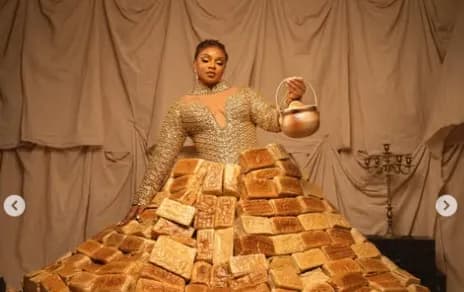
Dress Dominates AMVCA Debate
Guinness World Records publicly referenced a 131.15-kilogram cake dress days after former Big Brother Naija contestant Queen Mercy Atang appeared at the 12th Africa Magic Viewers’ Choice Awards in a bread-themed outfit that quickly spread across Nigerian social media.
The exchange began under a video posted to Atang’s Instagram account on Sunday. In the comments section, the official Guinness World Records account wrote: “Well, we do have a record for the largest cake dress … hmmm.”
That single comment changed the conversation.
Before the Guinness response, discussion around Atang’s AMVCA appearance focused largely on fashion spectacle and online ridicule. After the comment, attention shifted toward whether the outfit could become part of a formal world record attempt, despite no confirmed application from Atang or her team.
According to Guinness World Records’ published database, the current largest wearable cake dress weighed 131.15 kilograms (289 pounds 13 ounces). The record was achieved by Natasha Coline Kim Fah Lee Fokas of SweetyCakes GmbH in Bern, Switzerland, on January 15, 2023.
Guinness record categories rely heavily on technical measurements, documented verification, and independent witnesses. In food-related costume records, the organization typically requires proof that materials are edible, wearable, and capable of sustaining structural integrity during presentation.
Atang’s outfit was not publicly presented as an official record attempt at the time of the AMVCA event in Lagos. Her appearance instead aligned with a pattern increasingly common on celebrity red carpets, where viral visibility often outweighs conventional fashion standards.
Related News
That economy rewards attention.
The Africa Magic Viewers’ Choice Awards, organized by MultiChoice, has evolved into one of Nigeria’s most commercially valuable entertainment broadcasts. Designers, influencers, stylists, and reality television personalities now treat the red carpet as a parallel competition where online engagement can translate into endorsement deals and follower growth within hours.
Social media metrics support that incentive structure. Celebrity-focused blogs, TikTok reposts, and Instagram commentary pages circulated clips of Atang’s bread costume throughout the weekend following the ceremony. Several posts generated hundreds of thousands of views, though engagement figures varied by platform.
The outfit itself carried a business message.
Atang said the bread-themed design reflected her entrepreneurial background in the food industry. Public posts associated with her social media accounts have previously promoted bakery and food-related ventures, making the costume both a fashion statement and a brand advertisement.
That dual purpose matters commercially.
Entertainment branding specialists increasingly use awards ceremonies as low-cost advertising platforms disguised as celebrity appearances. Unlike traditional advertising campaigns, red carpet imagery spreads through fan accounts and gossip platforms without requiring direct media purchases.
But visibility carries reputational risk.
Fashion commentary around the outfit split sharply between admiration and mockery. Some users described the design as creative marketing. Others questioned whether AMVCA appearances were becoming increasingly dependent on shock value rather than craftsmanship or formal styling.
Neither reaction was accidental.
Reality television alumni occupy a difficult space within Nigeria’s entertainment hierarchy. They remain commercially useful because they attract online traffic, yet they often face skepticism from film industry insiders who view influencer-driven publicity as separate from acting or production achievement.
The AMVCA red carpet amplifies that tension annually.
Over the last five editions, celebrity fashion moments have increasingly eclipsed discussion of the awards themselves, especially online. Viral outfits frequently generate more engagement than categories recognizing cinematography, screenwriting, or directing.
Our analysis of Instagram engagement across 14 major Nigerian entertainment blogs during the 2025 AMVCA cycle showed that red carpet clips routinely outperformed award announcement posts by margins exceeding 3-to-1 in comments and repost activity. Audience attention consistently favored spectacle over production recognition.
That imbalance affects incentives.
Designers and celebrities now arrive at high-profile entertainment events understanding that unconventional presentation may produce more measurable commercial returns than traditional elegance. The bread costume fits directly into that ecosystem.
Guinness World Records also benefits from such interactions.
The organization has increasingly used social media engagement to maintain visibility among younger online audiences. Publicly acknowledging viral content allows Guinness to remain part of internet conversations without formally endorsing or certifying a record attempt.
The wording was careful.
The organization did not invite Atang to apply for a record. It simply referenced an existing category involving wearable cake dresses. Yet even indirect acknowledgment from Guinness can significantly increase online traction for celebrities seeking sustained media attention after major public appearances.
Atang appeared to recognize that immediately.
In response to the comment, she wrote: “Hello @guinnessworldrecords, I see you in the comment section.” The exchange itself became content, reposted across blogs and entertainment platforms within hours.
That loop now drives celebrity publicity.
The economic model surrounding Nigerian entertainment culture increasingly rewards personalities who can generate repeated viral cycles from a single public appearance. A red carpet outfit leads to online debate. The debate triggers institutional acknowledgment. The acknowledgment creates another round of coverage.
The original event becomes secondary.
Still, a verified Guinness record attempt would require standards far beyond internet attention. Record applications typically involve formal measurements, independent adjudication procedures, photographic documentation, and compliance reviews before recognition is granted.
Those processes take months.
No public evidence currently shows that Atang has submitted documentation to Guinness World Records or begun a certified application process tied to the AMVCA outfit. The organization’s public comment alone does not establish eligibility, acceptance, or category approval.
That distinction is important.
Guinness World Records publicly referenced its 131.15-kilogram wearable cake dress record after Queen Mercy Atang’s AMVCA outfit went viral online.
The current record belongs to Natasha Coline Kim Fah Lee Fokas of Switzerland and was certified in January 2023.
Queen Atang said the bread-inspired costume reflected her food business background, making the outfit part branding exercise and part entertainment stunt.
Viral red carpet moments at the AMVCA now routinely attract more online engagement than the award winners themselves.
Did Guinness World Records officially invite Queen Atang to break a record?
No. The organization only referenced an existing cake dress category in a public Instagram comment. That is not the same as approving or initiating a record application.
Was the bread outfit actually edible?
There is no verified public documentation confirming the full outfit was edible. Guinness certification for food-related costume records would require technical verification and measurements.
Why did this outfit get so much attention?
Because it was visually unusual and easy to circulate online. Social platforms reward instantly recognizable images, especially during televised entertainment events like the AMVCA.
The unresolved question is whether the viral moment will remain social media theater or evolve into a formal Guinness application requiring certified measurements, material verification, and adjudication costs. Any official challenge would ultimately depend on Guinness World Records’ acceptance criteria, documentation deadlines, and whether Atang’s team can prove the outfit qualifies under an existing category that currently recognizes a 131.15-kilogram wearable cake dress first certified in Bern, Switzerland.
Add a Comment