


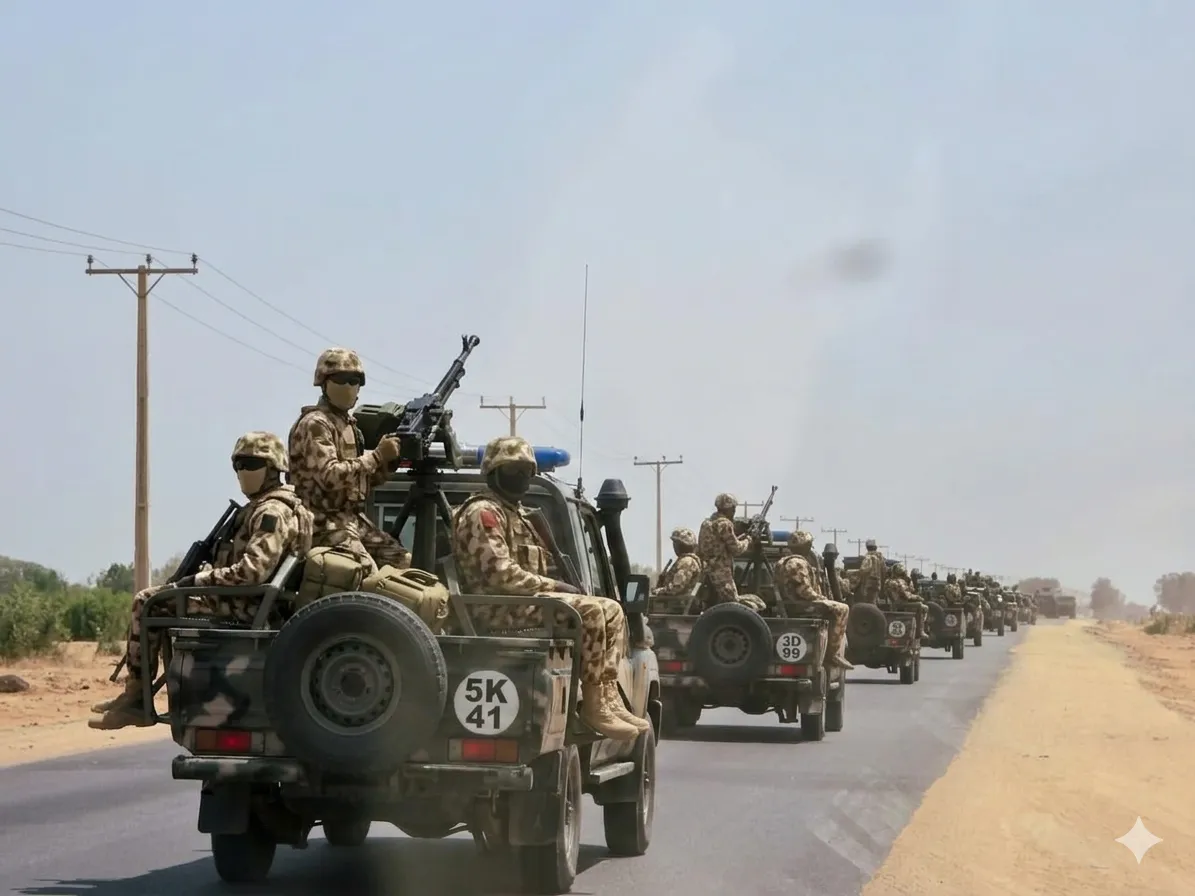
Sixty-one ISWAP fighters were killed and four Nigerian soldiers wounded early Wednesday morning when troops of Operation Hadin Kai (OPHK) repelled a coordinated assault on the 68 Battalion position in Malam Fatori, Abadam Local Government Area of Borno State, according to sources with direct knowledge of the operation who spoke to security analyst Zagazola Makama.
The attack came from the Duguri general area, advancing through the frontage of Bravo Company. ISWAP fighters moved on foot and deployed armed drones in what sources described as a deliberate attempt to breach fixed defensive positions. The Nigerian Air Force responded with four air interdiction strikes on identified enemy concentrations. It worked.
That is the military's version.
The assault began before dawn. Sources told Zagazola Makama that the attackers advanced through the Duguri general area, targeting Bravo Company's frontage. The use of armed drones alongside foot soldiers reflects a tactical pattern that OPHK official Lt. Col. Sani Uba confirmed in a parallel November 4, 2025 incident at Forward Operating Base Kangar in the same town, where ISWAP "launched a coordinated assault...involving the use of armed drones and mortar fire." Naija News
Drone deployment in this zone is not improvised. It is rehearsed.
Nigerian ground forces, supported by the Nigerian Air Force, engaged the incoming fighters with what sources described as "overwhelming firepower." The four air interdiction strikes are the operational centerpiece of the military's account. In comparable operations at FOB Kangar, field commanders described the counterattack as absorbing an initial barrage before "a reinforcement team from the main battalion swiftly joined the fight, mounting a counteroffensive," ZAgazola a sequence that appears consistent with what sources described in Wednesday's engagement at the 68 Battalion location.
After the strikes, survivors withdrew toward the Arege general area.
Four soldiers sustained minor injuries during the engagement and have since been stabilized, according to sources. That figure, if accurate, represents a notably low own-casualty count against a stated enemy body count of 61. For context, a militia leader assisting troops in Malam Fatori, Babakura Kolo, reported 14 soldiers injured and nine ISWAP fighters captured during a separate November 2025 engagement at the same location, with ISWAP itself claiming in a subsequent statement that its fighters "killed and wounded" 12 soldiers. The Defense Post Casualty figures in the Malam Fatori corridor have a documented history of diverging between military sources, militia accounts, and insurgent claims.
Related News
- A Nigerian skate brand just became adidas' first official Nigerian collaborator.
- A senior ISWAP finance operative surrendered to Nigerian troops at 6:45 a.m. on July 25 along the Gamboru-Wulgo Main Supply Route in Borno State.
- Nigeria's reported digital payment fraud losses fell 52 percent last year, dropping to N25.85 billion from N52.26 billion in 2024.
The Role of Niger and the Drone Question
The most consequential detail in Wednesday's account may not be the body count. It is the Niger Republic's air assets.
Allied Nigerien aircraft conducted "rapid strike passes" against fleeing insurgents after the primary engagement, according to sources. The battle damage assessment from those sorties was still ongoing at the time of this report. That means the confirmed casualty figure of 61 is a floor, not a ceiling, and the final toll from the joint operation will not be known until Nigerien forces complete their assessment.
A July 2025 joint Nigeria-Niger operation in the same Malam Fatori area similarly relied on "real-time surveillance from the Nigerien Air Force" and "intelligence, surveillance, and reconnaissance capabilities of the Nigerien Defence Force, which played a pivotal role in guiding Nigerian troops." PRNigeria The bilateral operational relationship is functional and apparently deepening. What is not yet public is the formal agreement structure governing rules of engagement for Nigerien aircraft conducting strike passes inside Nigerian territory.
The drone dimension compounds this. ISWAP's armed drone use in Malam Fatori is now documented across at least three separate engagements in 2025. In one documented incident, three enemy drones were spotted conducting aerial reconnaissance over a battalion headquarters before mortars and small arms followed, Nigerian Eye suggesting ISWAP uses drones for pre-assault surveillance, not just weapons delivery. The Nigerian military has not publicly disclosed its counter-drone protocols or whether any hostile drone was downed on Wednesday.
The New Humanitarian's June 2, 2025 analysis noted that ISWAP "is now enjoying the most successful period in its history," following a string of base attacks in Borno, including the overrunning of Buni Gari military camp on May 2, 2025, home to the Nigerian Army's 27 Task Force Brigade, a key component of Operation Hadin Kai. The New Humanitarian
Wednesday's outcome, if the sourced figures hold, would represent one of OPHK's highest single-engagement ISWAP casualty tolls of the year. But the same town where 61 fighters allegedly died on Wednesday is the town where, on January 24, 2025, ISWAP overran the Nigerian Army's 149th Battalion, killing a commanding officer and at least 20 soldiers, with survivors reporting the attack lasted more than three hours. Al Jazeera Malam Fatori has changed hands, operationally speaking, more than once. The military's current dominance there is real. It is also contested.
Our analysis of the pattern of attacks in Malam Fatori across 2025 shows ISWAP returning to the same target geometry repeatedly, adjusting tactics after each repulse, adding drones to what were previously ground-only assaults.
Add a Comment