


According to the Colombian Association of Capital Cities.
The quake struck as Colombia's new president, sworn in over the weekend, faced his first major crisis, and as three cities imposed curfews within hours to stop looting amid the wreckage. The scale of destruction, more than 20 municipalities hit and at least 61 buildings collapsed, will shape how the country's newly inaugurated government is judged in its opening days.
The epicenter sat near San José del Palmar, a rural mountain community in Chocó department with roughly 4,800 residents, at a depth of about 96 kilometers, according to Colombia's geological service, which called it one of the strongest earthquakes to strike the country in recent decades. The tremor hit at 12:34 UTC, roughly 7:34 a.m. local time, and was followed within the hour by a 5.0 magnitude aftershock, the U.S. Geological Survey reported.
President Abelardo de la Espriella, in office barely a day, said 61 buildings had collapsed and 1,575 homes were damaged, with 87 people injured, and he declared an emergency to expedite recovery funding. The Colombian Association of Capital Cities' updated toll of 132 dead and 570 injured came later Monday and superseded the president's earlier figures, a common pattern in the first hours after a major disaster when parallel counts run ahead of each other.
De la Espriella traveled to Cali to coordinate the response and said he would go on to Quibdó, capital of Chocó, one of the regions hit hardest. The USGS put the odds of the death toll eventually topping 1,000 at roughly one in three.
Curfews, Looting Threats
Cali's mayor, Alejandro Eder, ordered a curfew running from 8 p.m. to 6 a.m., citing threats of looting recorded during the emergency caused by the quake. "Tenemos amenazas de saqueo, por eso he ordenado el toque de queda y la militarización de Cali," Eder said, according to a statement carried by Diario Occidente. He also declared a public calamity and activated a hospital red alert, and asked residents to report any looting or security incidents promptly.
Manizales, Pereira, Armenia and the smaller towns of Roldanillo and Dosquebradas followed with curfews of their own before midnight, according to Colombian outlet La FM, each citing the same rationale: preventing nighttime looting and clearing streets for rescue crews. Manizales imposed its curfew from 10 p.m. Monday until 5 a.m. Tuesday.
Related News
- Thailand School Shooting Leaves 2 Dead, Up to 20 Injured
- Two employees of France's Prime Minister's Service have died by suicide in recent months, and several colleagues have attempted suicide.
- UK Health Security Agency declared amber heat-health alerts for four English regions on Sunday, covering London.
By evening, Valle del Cauca Governor Dilian Francisca Toro said the death toll in her department alone had reached 27, and de la Espriella, after meeting with regional officials, said more than 1,000 additional soldiers and police would deploy to Cali by Tuesday morning to contain looting attempts already under way, according to a live broadcast by BluRadio. The same broadcast reported 188 people missing in Valle del Cauca and put the region's power outage at 27 percent, with Chocó's grid roughly 60 percent down.
City-Level Toll
The city tolls, still developing, diverged sharply from the national figure and from each other. Pereira's mayor, Mauricio Salazar, said at least 18 people had died there, while Manizales Mayor Jorge Eduardo Rojas initially reported two deaths before revising the city's damage count to 17 buildings collapsed and 19 more partially collapsed, including a tower of the city's neo-Gothic cathedral, which fell onto the nave.
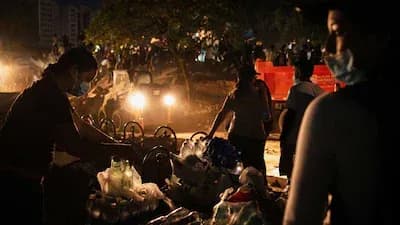
In Cali, Eder said at least 20 buildings had collapsed, some with people trapped inside, and that emergency teams had set up tents to coordinate rescue efforts. The city, home to roughly 2 million people, was in the middle of a weeklong festival celebrating Afro-Pacific culture that draws hundreds of thousands of visitors when the quake hit, according to NBC News.
A taxi driver in Cali, Jorge Moncayo, 64, described the shaking to CBS News: "My entire house shook. I've never lived through such a powerful earthquake."
Communications into Chocó, the region closest to the epicenter, remained patchy hours after the quake. Phone signals were out in many parts of the region's capital, Quibdó, and San José del Palmar itself has no airport and sits on a mountain ridge along the highway linking Cali and Pereira, complicating access for rescue teams. Chocó Governor Nubia Carolina Córdoba-Curi described injuries and significant damage to buildings in Quibdó and warned that aftershocks were already being detected.
Six airports, in Pereira, Manizales, Armenia, Cartago and Buenaventura, were closed to regular traffic and reserved for medical and government flights while crews inspected runways and terminals for structural damage. A seventh, in Popayán, faced separate restrictions tied to volcanic activity nearby, according to BusinessToday.
The tremor was felt beyond Colombia's borders, reaching Venezuela's Táchira state and the city of Barquisimeto, as well as Ecuador and Panama, though no significant damage was reported in those countries. The U.S. State Department pledged $15.5 million in disaster assistance Monday night.
What remains unresolved is the death toll itself. The Colombian Association of Capital Cities' count of 132 was already higher than the president's own figures released hours earlier, and officials in Cali, Chocó and Valle del Cauca have not yet reconciled their separate tallies into a single national figure. Search teams are still working through rubble in Cali, Pereira and Quibdó, and de la Espriella has not said when his government will issue a consolidated casualty report.
Add a Comment